Showing posts with label Villain Week. Show all posts
Sunday, May 8, 2011
Villain Week: Day Seven
Welcome to day seven of Villain Week! Today's topic is:
Villain Week Wrap Up! (Stargate Style)
______________________________
I've been trying to think of a good way to end Villain Week, something that will let it go out with a bang and not a whimper. So far this week we've seen a list of my favorite literary villains, investigated the role of the state as a villain in dystopian literature, took a somewhat satirical look at the role of villains in film and TV, decided who were the greatest animated villains of all time, listened to some rockin' villain tunes, and explored three real life baddies. In the end, I couldn't really think of anything that I hadn't already done.
It didn't escape my notice, however, that the last day of Villain Week falls on the day before the final episode of Stargate Universe, the last remaining television show in what I believe to be one of the finest franchises in science fiction. There are those of you who've never watched Stargate and, therefore, won't really care, but for me this is a sad day. It's very rare for me to find a television show that I enjoy, let alone three of them. This is the end of an era (until the inevitable reboot twenty years down the road) and I've decided to utilize Villain Week as a way to pay my respects.
So, thank you for bearing with me this week and for all of your encouraging comments. I'm glad to know that people actually enjoyed Villain Week. Without any further ado, here are my favorite villains from the Stargate universe.
______________________________
Show: Stargate SG-1
Character: Ba'al
Ba'al is, as far as I know, Stargate SG-1's longest running villain. Beginning in season five, Ba'al continued to torment and torture SG-1 right up until the very end, including one of the franchise's SG-1 films. Ba'al is my absolute favorite villain from all three Stargate shows because he's just so darn good at being evil and yet lovable at the same time. He's sadistic, intelligent, conniving, murderous, and a very convincing liar.
One of my favorite Ba'al moments has to be when he is forced to work with SG-1 in season ten. Watching him and Sam Carter work together is one of those surreal moments that only good sci-fi can provide. He's an evil Goa'uld who just spent five seasons trying to kill them and now here he is helping them...for his own benefit of course.
Character: Replicator Sam
A humanoid Replicator created by Fifth (who was completely obsessed with Sam), Replicator Sam was devoid of all compassion, humanity, and, really, feeling of any sort. I mean, what were you expecting? She's a machine for crying out loud. Not only did she fit right in with the other Replicators, she surpassed them in evilness and in her desire to take over the known universe. Under her control, the Replicators became an even bigger threat, snatching up planets and technology left and right. She even tried to kill Daniel Jackson (although, anyone who has watched the show will know that that's a) not hard to do and b) no indication that he won't come back in the future). She was only on the show for a relatively short amount of time but she caused a lot of mayhem while she was there.
Show: Stargate Atlantis
Character: Todd the Wraith
While the Wraith don't actually have names, Colonel Sheppard decided to call this one Todd. As with any Wraith, Todd's existence depends upon sucking the life out of humans. Literally. Todd was first introduced to us when Sheppard was taken prisoner by the Genii (more about them later). Both he and Todd were being held in cages by the nefarious race and ended up working together to try to escape, despite the fact that they wanted to kill each other. Todd and the Atlantis expedition met each other on several occasions, each time working with each other for some sort of common goal...a goal that usually ended up benefiting the Wraith more than the humans. While not as evil and villainous as some of the other Wraith, Todd was still looking out for himself more than for the good of others and, until he agreed to be used as a lab rat for a retrovirus that allowed him to survive without feeding off of humans, he still killed people in order to live to see another day.
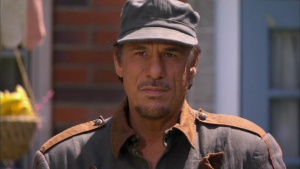
Character: Acastus Kolya
The Genii, one of the races of people descended from the Ancients in the Pegasus Galaxy, appear at first to be peaceful, quaint, and technologically deficient. We find out early on, however, that they are actually putting on a front in order to protect themselves from the wrath of the Wraith. They are, in actuality, more highly advanced and sinister than they seem. The Atlantis mission quickly gets on their bad side and the Genii send forces to take over Atlantis. Those forces are led by this guy.
Commander Kolya is cold, calculating, determined, and not above gratuitous violence. He'd shoot you as soon as look at you once you become his enemy. Throughout the first season, Kolya is a constant threat to the people of Atlantis. He even becomes a threat to his own government when he begins to plot a coup. He isn't successful and he is eventually killed but up until that point he keeps the members of the Atlantis mission, especially John Sheppard, on their toes.
Show: Stargate Universe
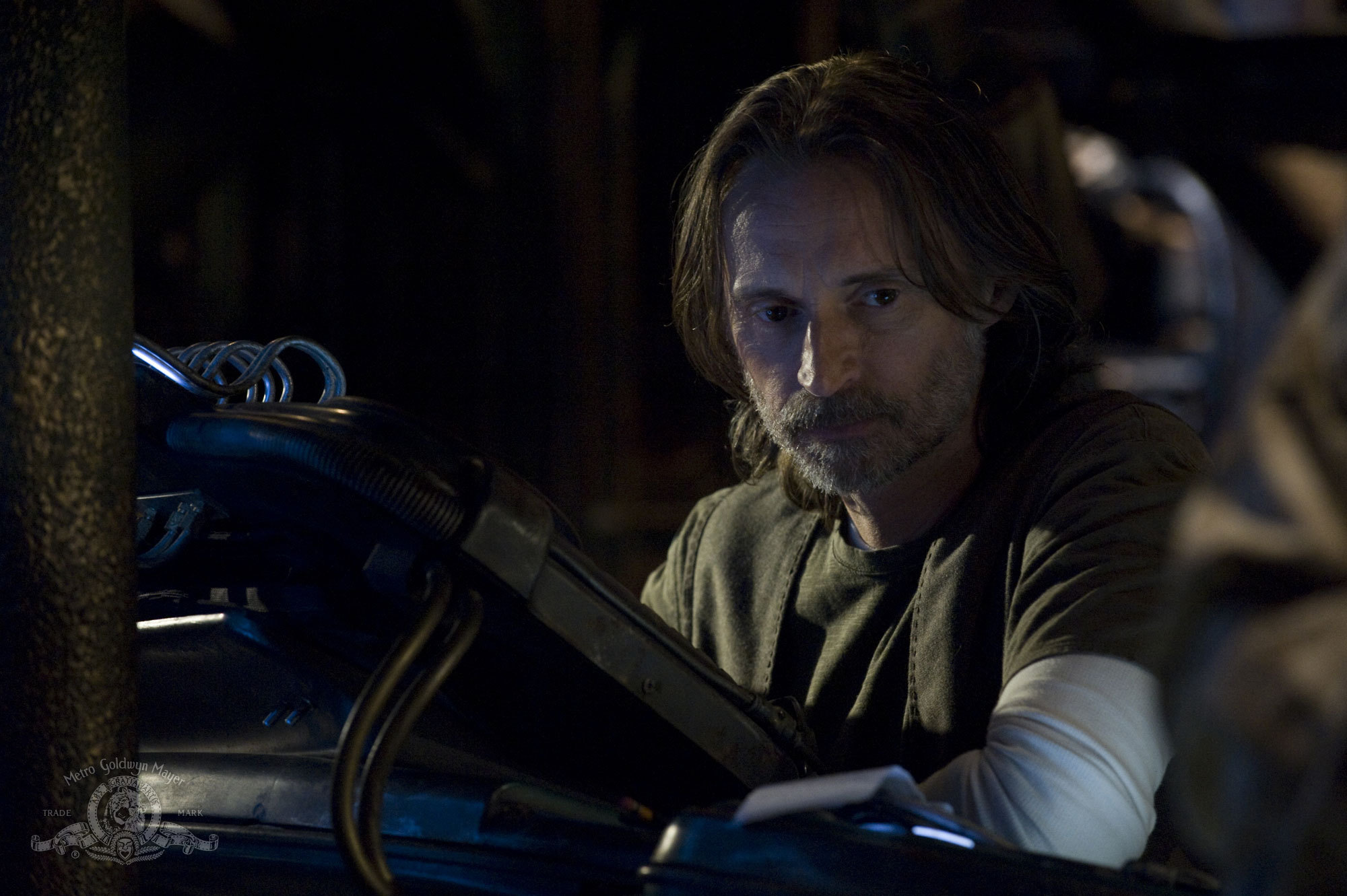
Character: Dr. Nicholas Rush
I'm including Dr. Rush in this list because, even though he's not technically a villain, he tends to be the main opposition force on the show. Stargate Universe is much different from the other two shows in the franchise because the conflict is mostly between the crew members on Destiny and not between humans and some sort of strange alien race.
So, what puts Rush on this list? He's a selfish man who is more concerned with himself than with others. Instead of dialing a different planet while the Icarus base is under attack, he dials the nine-chevron address in order to prove that it can be done, thereby stranding dozens of people on the other side of the universe in a spaceship they really have no business being on. He's a Machiavellian kind of guy who constantly puts the ship and its people in danger in order to achieve some sort of goal as well as to ensure that he retains some sort of power over his circumstances. He and Colonel Young go head-to-head all the time over who's really in charge and he even keeps the fact that he can control the ship to himself until it best benefits him. Over time he has undergone changes that have softened his personality somewhat, but in the first season and the beginning of the second season it was fun to watch and see what subtly undermining thing he would do next.
_________________________________
That's it, folks! Villain Week has officially come to an end. I've already read three books and have started on a fourth, all of which will be reviewed in the coming days. It's back to solidly bookish posts from now on but I sincerely hope that you've enjoyed Villain Week as much as I enjoyed writing it.
-Gabe
Labels:
Villain Week
Saturday, May 7, 2011
Villain Week: Day Six
Welcome to day six of Villain Week! Today's topic is:
Going Down in History: Villains in Real Life
__________________
I was one of those crazy people who decided to get a Bachelor's degree in something I like rather than something that would get me paid. History has been a love of mine since I was a kid and so it made sense to major in it. Just like in fiction, film, and television, I seem to have an affinity for history's bad boys. Not the Polpots, Lenins, or Hitlers, but the ones who are, shall we say, less psychotic and genocidal. Today we're going to take a look at three of these people: Alcibiades, Judas, and Rasputin.
1) Alcibiades
I love ancient Greek history. I would eventually like to get a Ph.D. in Classics and teach Greek history at the college level but because so many colleges are eliminating their Classics programs, I might never get to do so. Instead, I'm going to
| Alcibiades is the guy in the middle. |
The Background Information (a.k.a. "the boring bits")
In 431 BCE, Sparta and Athens, two Greek city-states (or poleis) went to war with each other, backed up by their allies, who just happened to be other Greek poleis. This was the Peloponnesian War and was, for all intents and purposes, the ancient Greek version of the American Civil War. This war, however, wasn't fought over slavery or states' rights. Instead, the Greeks were fighting over trade/political power. Sparta thought that Athens had too much of both and wanted to make sure that its politicians didn't turn Greece into an Athenian empire. The war lasted until 404 BCE, when Athens finally got its a** kicked.
Why Is Alcibiades Interesting? (a.k.a. "the cool stuff")
Alcibiades was a Greek strategoi, or general, and was also a friend and student of Socrates, the Greek philosopher. He was insanely charming and handsome and had a slight speech impediment that made him even more lovable. He was also a bit of a boozer. He was chosen as one of three generals who were to lead a group of Athenian soldiers into Sicily to try and conquer them (for reasons way too complex to get into). Right before the troops were supposed to leave, a bunch of statues of the Greek god Hermes were defaced. Or, really, they were de-penised.
| These statues obviously survived the mysterious emasculation. |
This was a huge deal to the Athenians because one of Hermes jobs as a god was to look after travelers. They saw this as a bad omen but they were war-mongering jerks so they decided to go to Sicily anyways.
The real issue here was that there were some people in Athens who thought that Alcibiades was a political threat (probably because he got invited to all the cool parties and they were jealous) so they decided to try to pin the destruction of the statues on him and his no-good, booze-loving, hooligan friends. Instead of bringing him to trial immediately, they told him to go to Sicily and that they would call him back for a trial at a later date. Alcibiades knew that that meant they were trying to find more evidence against him and that when they came for him they'd probably have a built a pretty convincing treason case against him. If convicted, he would have faced the death penalty. Not really something that he was all that keen on.
His enemies built their case and recalled him back to Athens. While he was on the ship going back from Sicily Alcibiades made a decision. While we don't know what he actually said, I'm going to guess it went a little something like this: "Screw this, I'm getting the hell out of here." And he did. He jumped ship without anyone knowing and somehow made it to, of all places, Sparta. No one's sure how he got there, but it probably wasn't by swimming.
| "Sea turtles?" "Aye, sea turtles." |
So let's pretend that you're an Athenian general who's going to be tried for treason. You've just escaped from the ship that was taking you to almost-certain death and you find yourself in enemy territory. What are you going to do? Alcibiades decided to play it smart: he gave up all of Athens secrets. Yup, he was a regular old Benedict Arnold. In fact, he makes Benedict Arnold look like a patriotic citizen. Alcibiades got chummy with one of Sparta's two kings and started feeding him information. Quite a lot of it was old news and some of it was probably lies, but the king liked him and found him useful enough to keep around so Alcibiades was safe...for a time.
After a little while the king who liked him died. The second Spartan king, however, hated him and it wasn't because he was a sneaky little weasel. Alcibiades had slept with his wife...and gotten her pregnant. Now he had two city-states who wanted to string him up. Being a big fan of self-preservation, Alcibiades did what any man in his position would do. He ran away...to Persia.
Anyone who has studied Greek history (or, at least, watched The 300) will have learned about the Persian War. The Persian king was spreading his empire all throughout the region and wanted to snatch up Greece as well. The Greek city-states were like, "You've gotta be kidding me, right?" and they banded together to fight off the Persian onslaught. Although the Persian War had been over for fifty-some years by the time the Peloponnesian War broke out, it was still a pretty touchy subject in Greece. So for a Greek general to willing go to Persia was bad enough. To make friends with a Persian satrap (kind of like a governor) and feed him information was even worse. Alcibiades cranked the volume up to eleven, however, and fed the satrap information about two city-states, Athens and Sparta. That's right, he betrayed two countries with one stone.
To make a long story short (and believe me, I could talk forever about this guy), Alcibiades finally wore out his welcome in Persia. By that time there had been a coup in Athens and the leaders reinstated him as a general. They didn't know that he no longer held any sway with the Persians and thought that he could help persuade them to join with Athens in the the fight against Sparta. Alcibiades did what he did best and lied through his teeth, saying that he could do it. And they believed him. So, let's review here: he betrays Athens to Sparta and then he betrays Athens and Sparta to Persia and then he's given his job back. Because that makes sense.
Alcibiades didn't remain a general for very long, however. He won a lot of battles because in addition to being a lying, cheating jerk he was also a brilliant leader. The battle of Notium, however, spelled the end of his career. He left someone else in charge of a fleet of ships with strict orders not to engage in battle with the Spartans. The guy blatantly ignored those orders and lost spectacularly. Alcibiades got the blame for something he didn't even do and was promptly fired. The one time this guy isn't involved in disaster and he takes the fall for it. The even funnier part of this whole story is that after he was fired he tried to tell the Athenians about a huge mistake that they were making in their strategy and they wouldn't listen to him, leading to defeat in battle and, ultimately, the war. In other words they believed him when they shouldn't have and they didn't believe him when they should have. Classic case of boy cries wolf.
Alcibiades died shortly after this but it wasn't from heartbreak or anything romantic like that. He was, in fact, murdered. The circumstances surrounding his death aren't fully known but by that time he'd made enemies all over the Mediterranean so I guess I can understand why it would be hard to narrow down the list of suspects.
2) Judas Iscariot
I've talked before about how I'm not Christian (or, really, any religion) but as a historian I don't doubt that someone named Jesus bar Joseph lived anymore than I doubt that Mohammed or Buddha were real people. It would follow, then, that people like Judas Iscariot were also real. I may not believe in the Bible or the Koran or any other religious text but historically speaking it would seem that people with these names walked the earth at one time.
| Judas as portrayed by Luca Lionello in The Passion of the Christ. |
Background Information (a.k.a. "the boring bits")
Judas Iscariot was, according to the Bible, one of Jesus' twelve disciples. He was also Jesus' betrayer. The story goes that Judas was bribed with thirty pieces of silver by priests who wanted to arrest Jesus. In the garden of Gethsemane the night before a feast, Judas approached Jesus while he was praying and identified him to the men who had come to arrest Jesus by kissing him. Jesus was arrested and was eventually crucified. Judas is said to have either died by hanging himself or by bursting open in the middle of a field that he had purchased with his "blood money." How's that for karma?
Why Is Judas Interesting? (a.k.a. "the cool bits")
Judas' name has become synonymous with the word betrayer. This goes for secular as well as religious culture. Even non-Christians use the name in that way, showing the extent to which the story of Judas has transcended boundaries. His name pops up in film, literature, and music all the time. Judas left behind him a legacy of betrayal that many Christians still hate him for. There are even some (although probably not very many) who use his traitorous act as an excuse for anti-Semitism.
A newly(ish) discovered Gnostic text, the Gospel of Judas, offers a different explanation. It proposes that Judas was actually one of Jesus' most loyal apostles and was asked by Christ to betray him just as Peter was asked to deny him. While the veracity of the text is, obviously, in dispute, there are other scholars and laymen who have suggested this same theory. Without someone to betray him, Jesus would never have been crucified. For Christians this means that he would not have sacrificed himself in order to forgive the sins of the world. It seems logical that there would have been some forward planning just to make sure that things went off without a hitch but of course there's no way to know that for sure.
The existence of the Gnostic text is interesting although by no means definitive. If it isn't a fake, the prevalence of anti-Semitism in the Roman Empire at the time of the Council of Nicea (which, among other things, set down the books that would be considered canon) could explain why it was left out of the Bible. This is all conjecture on my part, of course, but what good is life if you can't think about things and theorize? Later on this summer I'm planning on reading a biography of Judas which, given the paltry number of times he's mentioned in the Bible, isn't actually a biography of his life but is, instead, a biography of his portrayals in media and society and the impact he has had on the world at large throughout history.
3) Grigorii Rasputin
I had mentioned a few days ago that I really liked the character of Rasputin in the animated film Anastasia. I had also mentioned that the film contained blatant historical inaccuracies. For one thing, Rasputin never sold his soul. For another thing his actions did not directly lead to the Bolshevik Revolution (although he can be considered an impetus). After seeing the movie as a kid I became obsessed with the Romanov family and finding out everything that I could about them. In the end I found Rasputin to be a far more interesting individual than all of the Romanovs combined. My fascination with him continues to this day; in fact, I even did a research paper on him for a course I took in college about 20th century Russia.
Background Information (a.k.a. "the boring bits")
The Romanov family ruled Russia for a little over 300 years. Some well-known Romanovs include Peter the Great, Catherine the Great, and Nicholas the II (and not so great). Czarism in Russia lasted for much longer than that but it was the Romanov family, Czar Nicholas in particular, who brought it crashing to a halt, inadvertently ushering in the era of Communism and the Soviet Union. Nicholas the II had no real leadership qualities and was a rather indecisive man who relied on others, including his wife Alexandra, to tell him what to do. Under his rule, conditions in Russia worsened, leading to more poverty, starvation, and misery. He also, against all reason, took charge of his own military during World War I, which led to the deaths of scores of Russians and several lost battles. The anger that people felt towards him fanned the flames of revolution in Russia and gave Lenin, Trotsky, and the other Bolsheviks a reason to incite people to violence against their government.
Why Is Rasputin Interesting? (a.k.a. "the cool bits")
Rasputin was a Christian mystic about whom much is known but little is understood. This is because there are myths surrounding him that go back as far as his childhood. Some say he had magic powers, others believe him to be a hypnotist. Regardless of the real story, Rasputin wiggled his way into the Romanov family by way of Alexandra and the Romanov's only son, Alexei. Born with hemophilia, Alexei was prone to accidents and fits and doctors weren't having much of an effect. Rasputin discovered a way to calm him down and, Alexandra believed, heal him. She quickly made him Alexei's primary caregiver and he was given almost free reign of the imperial palace.
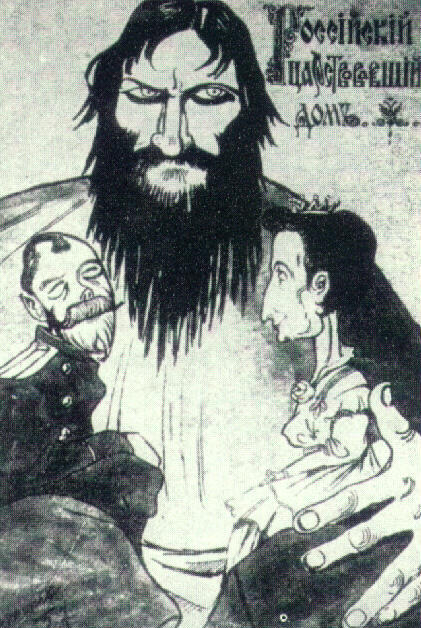
A boozing womanizer, Rasputin was believed to have been involved in orgies and other sexual deviances. These stories may be true or they may stem from the fact that he belonged to a misunderstood sect of Christianity called the khlysty, around which swirled many rumors. He was also, although this has never been proven, allegedly Alexandra's lover. This is most likely a lie created by enemies of the Romanovs who wished to discredit the family in order to eventually overthrow them. Cartoons were circulated around Russia of the "Mad Monk" and the Czar's wife in a compromising position, causing an uproar and leading to further distrust of both the Romanov family and of Rasputin.
While the full extent of his influence isn't known, most scholars agree that he held some sort of political power. He never held an office himself, but it is almost certain that he did convince the Czar to appoint people of his choosing to political positions. Alexandra acted as the middle man, dropping hints to her husband based on what Rasputin told her. He also may have influenced policy decisions and other important aspects of Russian government.
| A cartoon depicting Nicholas and his wife sitting in Rasputin's lap. |
The coolest thing about Rasputin, however, is his death. Many people have heard the story of Rasputin's "prophecy," the one that stated that if he was going to die before the new year and that if someone from Nicholas II's family had anything to do with it that the Romanov family would die soon after. I'm not talking about that part of the story because I think it's a bunch of malarkey and that the letter he supposedly left was probably a fake. What I'm talking about is how he actually died.
A friend of mine told me once that Rasputin probably had horcruxes because this guy was insanely difficult to kill. A distant relation of the Czar had a beef with Rasputin so he and some friends invited him over for a "party." They told him to meet them in the lower level of the house for what amounted to some early 20th century pregaming while someone upstairs played music and made noise to pretend that there was a crowd of people up there. In the basement, Rasputin was given some booze and some poisoned food, which he downed like it was the first time he'd eaten in decades. But he didn't die. So they tried a different tactic: they shot him three or four times. And he still didn't die. In fact, he tried to run away and was chased and beaten. Hoping to make sure he was dead this time, they wrapped his body in a carpet and threw him off a bridge into an icy river. Instead of drowning, Rasputin broke out of the carpet but was overtaken by hypothermia and subsequently died in the river that night. Yep, you read that right. He was poisoned, shot, beaten, and thrown off a bridge but he died from exposure. Rasputin was a fracking BAMF.
_________________________
Sorry this was so late in coming. I haven't slept much in the last week and I've only been near a computer for the last two days.
Tomorrow marks the end of Villain Week and the return of my regularly-scheduled reviews and other bookish posts. I hope that you enjoyed my little detour into the world of the delightfully evil. I'd love to hear what you guys thought of it.
Look forward to reviews of A Walk in the Woods by Bill Bryson, The Complaints by Ian Rankin, and Numb by Sean Ferrell (as well as other books) next week.
-Gabe
Labels:
Villain Week
Friday, May 6, 2011
Villain Week: Day Five (prescheduled)
Welcome to day five of Villain Week! Today's topic is:
They Steal. They Kill. They...Sing?: Villain Songs
____________________________
I'm a huge fan of musical numbers. I love showtunes and I miss the days when Disney films used to have soundtracks chock full of hummable music. I've noticed over the years, however, that I prefer songs sung by evildoers to love ballads or heroic tunes. I find that villains tend to have the best songs, whether we're talking a Tony-winning musical or a Disney film. I'm not sure why that is, but today I'm going to talk about my favorite villain songs.
ANIMATED VILLAIN SONGS
1) "Hellfire" from The Hunchback of Notre Dame (sung by Frollo)
I mentioned yesterday that I fracking love this song. It's the darkest song ever used in a Disney film and it really gets at the heart of Frollo's depravity. It also shows how delusional he is. Praying to the virgin Mary he says, "You know I'm so much purer than/the common, vulgar, weak, licentious crowd." Sounds like someone needs a wake-up call. The coolest thing about this song, however, is the fact that it uses a Latin choir. I love when songs use a Latin choir. It's why I love the band E Nomine, a German group that combines techno-ish music with a creepy German guy talking over a choir belting out lyrics in Latin. The video below, "Vater Unser," is the Lord's Prayer in German. It might seem a little odd but it's actually really amazing.
But, I digress. "Hellfire" is probably my favorite animated villain song, but there are so many other great ones. Like...
2) "In the Dark of the Night" from Anastasia (sung by Rasputin)
What's not to love about this song? Rasputin is so delightfully sinister and yet he's surrounded by those cute little bug things that comprise his choir. The whole song is about how he failed to kill all of the Romanovs and so his soul can't rest until he snuffs out Anastasia. He talks about his evil plan, sings a few words of Russian, and wears a wig. It's also catchy, memorable, and has pretty decent lyrics. I don't know about you, but I'd call that a successful villain song.
3) "Savages" from Pocahontas (sung by pretty much everyone)
Okay, so I wasn't sure whether or not I was going to put this one on the list because Ratcliffe's actual villain song is "Mine, Mine, Mine" (which I also love). This song, however, is unique in that neither party (the Native Americans and the British) is particularly good at this point and they both want to kill the crap out of each other so in this context I'd say they're both being kind of villainous. You also get our heroine, Pocahontas, risking her life to save the man she loves which, while historically inaccurate, does further prove that she's in the right and therefore everyone else is in the wrong. Besides, any song where people are being racist, genocidal jerks deserves to be considered a villain song.
I love how emotional this song is. It's very angry and, therefore, very powerful. The drums keep a sinister beat in the background and the choral parts are gorgeous as well as mildly terrifying. The idea that these people are planning to kill each other and are singing about it is kind of bone-chilling. So, sure, this isn't technically a villain song, but it's my blog and this is my list so there. (I'm very mature, I know.)
4) "Be Prepared" from The Lion King (sung by Scar and a bunch of giggly hyenas)
Scar, as we learned yesterday, is a power-hungry megalomaniac with murderous tendencies and a lack of leadership qualities. He can also carry a tune. "Be Prepared" is the kind of villain song that I wish was in every movie. Good lyrics, fun music, and goose-stepping hyenas. Okay, you can leave that last bit out. But the Hitler imagery in this song is rather striking. It's one of the reasons why this song is so creepy. You have the crazy villain and his even crazier followers believing everything he tells them. We as the audience know that he's going to completely ruin everything, but they have no idea that the proverbial wool is being pulled over their beady little eyes. I think this song comes in second, right after "Hellfire," on my list of favorite Disney songs.
VILLAIN SONGS FROM MUSICALS
1) "The Riddle" from The Scarlet Pimpernel (sung by Percy, Marguerite, and Chauvelin)
Like "Savages," "The Riddle" isn't exactly a villain song. The villain in this show, Chauvelin (played by my favorite human being on the planet, Terrence Mann), actually has a few songs in this show--"Falcon in the Dive," "Where's the Girl?"--but none of them is as amazing as this song is. The basic premise is that Chauvelin is trying to get Marguerite to betray Percy, whom he suspects of being the Scarlet Pimpernel, a nobleman from England trying to save French noblemen from angry peasants during the French Revolution. Percy, in turn, thinks that Marguerite is cheating on him with Chauvelin, with whom she has a history. The three of them sing this awesome trio during a party.
My favorite line in the entire song is: "Every Judas once loved a Jesus." To me it's a powerful reminder of how much Percy doesn't trust his wife. Even as a non-Christian, I find that Biblical references can sometimes be welcome additions if they're used well.
2) "Pretty Women" from Sweeney Todd (sung by Sweeney Todd and Judge Turpin)
No, I won't post the film version of this song, so don't ask. While I actually really like the version that Johnny Depp and Alan Rickman did, George Hearn will always be my favorite Sweeney Todd.
So, here we have a very pretty villain song. It's a slow, melodic tune all about women who are pretty and the things they do that men appreciate--like weather-watching and flower-picking (can't say that I've ever enjoyed watching a woman watch the rain but to each his own I guess). The problem with this whole scenario is that the woman Sweeney's talking about is his dead wife, whom the Judge violated after sending Sweeney off to prison on a trumped-up charge just so he could steal said wife. The woman that the Judge is talking about is Sweeney's daughter, who he's been raising since her mother died and who is, for all intents and purposes, basically a daughter to the Judge. Yeah, it's that kind of musical.
To add to the villainy of the song, Sweeney is happy the judge is there because he thinks that he can finally get his revenge on the man for ruining his life...by slitting his throat with his straight razor. One of the things I love about this musical (and there are many things I love about this musical) is that no one is innocent, no one is the good guy. It's a bunch of horrible people doing horrible things to each other. By the end of the show, almost everyone in the cast has blood on their hands...literally. This song, however, is a nice break in all the shouting, killing, and being generally creepy and insane. There were a couple of tunes that I could have picked from this show, but I like this one because it's such a calm, serene song with such a dark undertone and meaning.
3) "Damned for All Time/Blood Money" from Jesus Christ Superstar (sung by Judas)
I played Judas in a play called Dust of the Road in college. To prepare for the part I did a little reading and I watched a few portrayals of Judas, including The Passion of the Christ and Jesus Christ Superstar. I had never heard this song before that but I soon fell completely in love with it. The passion and anguish that Judas portrays in this song are moving and the song's pretty catchy too, so that doesn't hurt. For some people, Judas is the ultimate villain, the betrayer of Christ, the epitome of the word "traitor." Others, however, take a sympathetic view, while still others see him as a hero because, without his betrayal, Christ wouldn't have been crucified and therefore the sins of the world wouldn't have been forgiven. Whether you believe in the Bible or not and regardless of what you believe about Judas, this song is incredible and I think it deserves a spot on the list of awesome villain songs.
4) "Master of the House" from Les Miserables (sung by the Thenardiers)
[WARNING: Contains some language.]
If you haven't seen the 25th anniversary edition of Les Miserables, stop what you're doing and go find a copy of it. I was incredibly impressed with it, despite the fact that Nick Jonas was playing Marius. The Javert in this version is insanely good and, I can't believe I'm saying this, I think I prefer him to Terrence Mann. (I feel like a traitor.)
But we're not here to talk about Javert. We're here to talk about the Thenardiers. This slimy couple lies, cheats, and steals from everyone they come in contact with. And they're proud of it. They don't care who they hurt as long as they get to the top. Hell, M. Thenardier steals from corpses after the battle on the barricade. Way to desecrate the dead, buddy. I love "Master of the House." It's funny, it's catchy, and it shows the absolute insanity and criminality of these characters. It's a great introduction to two very memorable characters, characters who are intimately wrapped up in events throughout the musical.
So, there they are, my top eight favorite villain songs. As always, your choices may be different. Let me know in the comments which ones tickle your fancy.
-Gabe
Labels:
Villain Week
Thursday, May 5, 2011
Villain Week: Day Four (prescheduled)
Welcome to day four of Villain Week! Today's topic is:
Animated Bad Guys: Villains the Whole Family Can Enjoy
________________________
Like most people alive today, I grew up on animated films, mostly made by Disney. Some of my absolute favorites are Aladdin, The Hunchback of Notre Dame, Fantasia, and Anastasia. Perhaps unlike most people, however, one of the first things I look for in an animated film is a really good (and by "good" I mean "bad") villain.
Without the Queen, Snow White would have just been a pretty girl living with a bunch of short guys. Without Ursula, Ariel wouldn't have been able to get her wish and would still be singing songs about how much it sucks to be a mermaid. And without Scar, Simba would never have become a man. Or, er, an adult lion. What I'm saying is that villains in animated films really compliment their heroes, perhaps even more so than in books or other types of films.
And so, I present to you: the best animated villains of all time.
1) Frollo (The Hunchback of Notre Dame)
Let's forget about how unlike the book this film is. It's pretty awesome in its own right. Lovable but ugly main character? Check. Hot gypsy chick? Check. Bone-chilling villain with a creepy song? Check.
Frollo is everything an animated villain should be. He has a personality, he's a deeply flawed individual, and he's bat-s*** insane. Right from the start, Frollo is portrayed as being a rotten guy. He kills an innocent woman and then considers throwing her baby down a well...outside of a church. Yep, that guy's going to hell.
The thing about Frollo is that he sees himself as being righteous and that's what makes him so much fun to watch. If he knew that what he was doing was wrong then he'd just be a common criminal. But the man is pious and he thinks that he's doing what God wants him to do and that makes him interesting.
His obsession with Esmerelda is troubling to him because he believes himself to be above carnal pleasures. As a result, he blames her because everyone knows that it's always the hot chick's fault. Never mind that he's a sexually repressed guy who spends most of his time talking to a hunchback and being a jerk. Nope, in the end it's the woman that gets the blame.
So, he's a misogynistic murderer who thinks he's doing God's work. Yep, sounds like my kind of baddie.
Plus (and I'll be talking about this tomorrow) he has one of the coolest villain songs in all of film history.
The relationship between Frollo and Quasimodo, our hunchbacked hero, is rather compelling. Frollo was going to kill him when he was a baby but was stopped by the Archdeacon (voiced by the always awesome David Ogden Stiers of M*A*S*H fame). He became a reluctant father figure to Quasimodo, even though he was cruel and kept him locked up in the bell tower of Notre Dame cathedral. Quasimodo looks up to Frollo, not seeing how depraved and evil he is until it's almost too late. The fact that Quasimodo, although deformed and ridiculed, tries to only see the good in people is why he's one of my favorite animated heroes. The fact that he changes by going through the crucible of seeing people he cares about almost destroyed by the man who raised him is why I find this movie so compelling, even though it differs greatly from the novel. Frollo is integral to this transformation and Quasimodo's love for him makes the end even more poignant.
2) Scar (The Lion King)
Scar is one mean lion. I'm guessing he didn't get a lot of hugs as a child. Cub. Whatever. As the brother of the king of Pride Rock, Scar has some jealousy issues to work through...which he doesn't. Instead, he kills his brother through the cunning use of wildebeests and then blames it on Johnathan Taylor Thomas. I mean, Simba. Tormented and feeling guilty for something he obviously didn't do, Simba, the heir to the throne, wanders off on his own and meets a meerkat and a warthog and has tons of adventures...while his evil uncle completely destroys the entire landscape. I mean, if I were Scar I wouldn't go through all the trouble of committing regicide just so that I could lower the property value of my domain. Lack of ruling abilities aside, however, Scar is a pretty nasty villain. He feels no guilt or shame and he has no problem ruining his nephew's life. He also is willing to work with the unsavory hyenas, convincing them that he'll give them riches beyond their wildest dreams and then screwing them over because he's just that much of a jerk. Oh, and he stole his brother's wife. Someone's been reading a bit too much Hamlet if you ask me.
As for his relationship with our hero, Simba, Scar is the reason behind all of Simba's suffering. He killed his father, banished him from Pride Rock, and then tries to kill him when he comes back to take his place as the rightful king. If Scar had been a decent ruler and hadn't caused everything to dry up and die, Simba wouldn't have had to worry about anything. He could have just lived happily ever after with his grub-eating friends and let bygones be bygones. But Scar has the same aptitude for leadership as a pig has for flying so Simba has to give up hakuna matata and man up to his responsibilities. And I thought my family's problems were bad.
3) Rasputin (Anastasia)
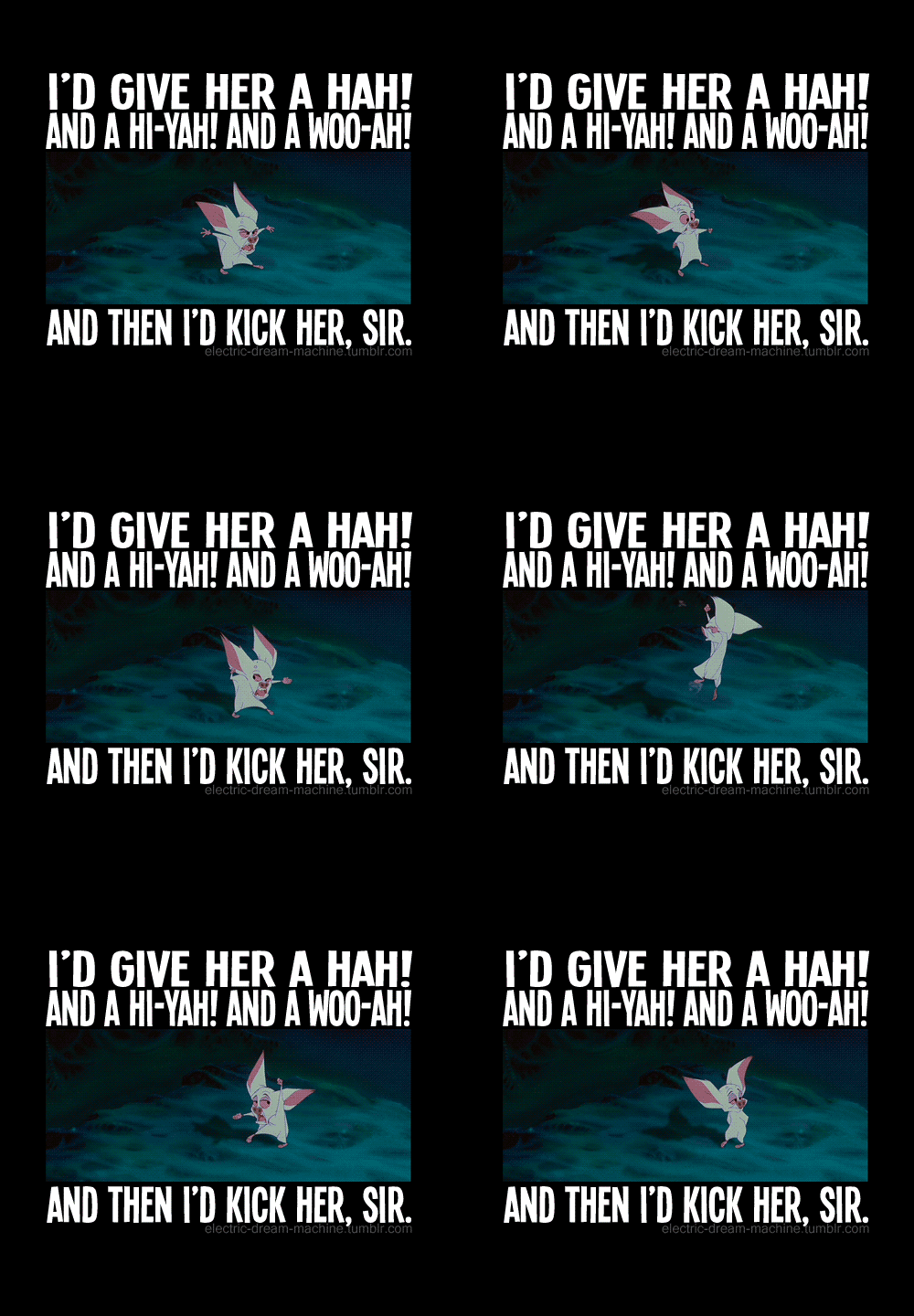
I'll be talking about the real Rasputin later this week, so I won't get into the blatant historical inaccuracies in this film. Anastasia began my obsession with all things Romanov when I was in the seventh grade (I was a weird kid) and Rasputin was always my favorite character in the movie. Okay, after Bartok.
| How can you not love this bat? |
Rasputin (the movie version) is pretty epic. The guy sells his soul, betrays the Russian royal family (leading to the Bolshevik revolution), and then comes back from the dead to hunt down and kill Anastasia. Plus he, like Frollo, has a pretty awesome song and dance number. He's remorseless, cruel, psychotic, and relentless--all good qualities in a bad guy. While he's not as awesome as the real life, flesh-and-blood Rasputin, he does a pretty good job of being evil.
Anastasia is one of the only Meg Ryan movies I can stomach (the other is French Kiss, but that's mostly because of Kevin Kline and Jean Reno). She's also a pretty decent heroine--stubborn, sarcastic, independent. She and Rasputin don't face off until the end but she makes a pretty good show of keeping him on his toes throughout the film. This is one of those good guy/bad guy relationships where the hero isn't really changed much because of the villain. Instead, Anya becomes a better person through her interactions with other people (Dimitri, Vlad, the Dowager Empress, etc.). I see this as a strength rather than a weakness. Rather than Rasputin affecting her, she affects him--although not in the "he becomes a better person" way. Instead, she just makes him angrier, more obsessive, and more violent. And, oddly enough, I like it that way.
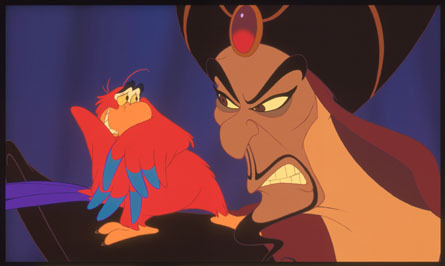
4) Jafar (Aladdin)
Jafar is probably, hands down, my favorite animated villain. He's greedy, sleazy, and his humor is drier than the desert. He also has that cool hypnotizing staff thing that I sometimes wish I could get my hands on ("No, professor, you don't want to assign us that paper." "I don't...want to...assign...that paper." "You want to give all of us A's." "I want...to give all of you...A's."). For all of his faults, Jafar's a pretty suave guy. I can't say I'd want one of my future daughters to bring him home to meet the folks, but he's a snazzy dresser and he's got that smooth-talking attitude that I love so much. Unlike a lot of villains, Jafar has the science of nefarious plans down to a "T". He's forward-thinking, flexible, and determined enough that he's not going to let a little setback ruin his day. Sure, he might scream a little and abuse his parrot, but he'll figure out another way to the throne. He even succeeds for a little bit, getting the sultanship (is that even a word?) and the girl before that nosy street rat screws everything up.
Despite the fact that he's a goody-goody and commits just as many crimes in the name of good as the ever-dull Jean Valjean, I actually like Aladdin. He's smart, romantic, and has a good heart. His relationship with Jafar is the epitome of the epic battle between good and evil. Just when it looks like evil is going to triumph, good swoops in and saves the day...with a little help from a big blue genie. Aladdin tries to be something that he's not but finds out that being yourself is far more important. And Jafar inadvertently helps him to realize this by revealing his true nature. It's fun to watch a film where the villain does something right when he's trying to do something wrong. Jafar thinks that he can break Aladdin's spirit by showing Jasmine who he truly is, but instead he only strengthens his spirit, leading to his eventual downfall--getting stuck in a fracking lamp with Gilbert Gottfried, which I think is enough to make any evildoer wake up in a cold sweat.
5) Ursula (The Little Mermaid)
I debated between her and Cruella DeVille but decided in the end that Cruella is really just a fashion-crazy chain smoker while as Ursula is pretty much made of evil. If Satan liked tentacles, he'd probably marry this woman...octopus...thing. Ursula is a witch, literally and figuratively. She preys upon innocent people who have self-esteem problems and uses them to gain power and influence. She's like the playground bully except she operates underwater and when you fail to meet her demands she takes a whole lot more than just your lunch money. Ursula is smart and sinister and downright spooky. She knows how to get inside your head, how to make you feel like she's your only hope for happiness. And people believe her. I don't really know why, but they do. Think of it this way: you really like someone but you don't feel that you're what they're looking for. You meet a woman whose eyes go all crazy and who sounds like she's been smoking six packs a day for the last 800 years and she's not really a looker or anything and she says that she can help you and you're just supposed to believe that she's not going to gut you if you cross her? I mean, look at her. She even looks nefarious. In some ways I think those poor suckers had it coming. I mean, they signed a contract for gods' sakes. Have they never read Faust?
Ursula is directly responsible for much of what happens to Ariel in this film. Not only is she the reason why this little mermaid gets legs, she's also the reason why she has no voice, why she almost loses the man she loves, and why she almost dies. Yeah, that's someone I want to sign a contract with. The strange thing is, however, that I'm really not sure how Ursula changes Ariel in the end. And, unlike Anastasia, Ariel isn't even directly related to Ursula's demise. That, according to this film, is the man's job. (I hope no women who watched this film got it into their heads that most guys would kill a giant octopus for them. I don't think I'd ever love someone that much.) In fact, Ariel doesn't seem to appreciate the life that she has even after Ursula almost kills her father. She still wants to have legs and go live with vapid Prince Eric. So, I guess we can say that despite being evil incarnate, Ursula doesn't really have a lasting effect on Ariel. She's still a raging psychopath though and I can appreciate that.
Obviously, your list may differ. I'd love to hear who your favorite animated villains are in the comments section.
-Gabe
Labels:
Villain Week
Monday, May 2, 2011
Villain Week: Day One (prescheduled)
I'm on vacation this week but I wanted to preschedule some posts so that my followers would still have something to read while I was away. I could have just posted the answers to the 30 Day Challenge that I've been participating in this month, but I didn't feel right about that. I wanted to give you guys something fun to read for the next week so, instead, I'm introducing Villain Week.
Anyone who's been following this blog regularly will know that I love bad guys. I love how multifaceted a well-written bad guy can be and I can't help but side with them sometimes against the often dull and predictable heroes that authors create. Call it a dislike of authority or a latent evil streak in my blood, but villains and other nefarious characters tend to be my favorites.
This is a link to a Top Ten Tuesday (The Broke and the Bookish) list that I did a few weeks ago. It's a list of my ten favorite villains/criminals/and other nasties in literature. I figure it's a good way to start off the week.
What else can you expect during Villain Week?
Wednesday: The Role of Villains in Film and Television
Sunday: Villain Week Wrap-Up
Don't worry, they're not just a bunch of lists. Here at Gabriel Reads, I strive for quality because, let's face it, you're worth it.
-Gabe
Labels:
Villain Week
Subscribe to:
Posts (Atom)