2012 is almost upon us and that means a new year of reading challenges. Considering I've been pretty lax on completing the ones that I had signed up for this year, I was trying to be a good boy and not join as many next year. And then I saw this challenge on Sarah Says Read.
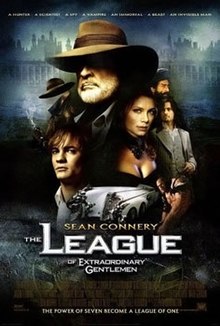
Hosted by Hanna at Booking in Heels, The League of Extraordinary Gentlemen Book Challenge is a year-long challenge that asks participants to read the books that each of the main characters in this film came from. Some I've already read and some I haven't, but I love a good reread so I don't mind.
I'm adding my own twist to the challenge and reading the original graphic novel by Alan Moore that the movie is (loosely) based on. I haven't read many (read: any) graphic novels other than Maus and I'd like to start.
I'll also be reviewing the film once I've finished all of the books. Here's what the challenge requires me to read:
1) King Solomon's Mines by H. Rider Haggard (Allan Quartermaine)
2) Dracula by Bram Stoker (Mina Harker) [reread]
3) 20,000 Leagues Under the Sea by Jules Verne (Captain Nemo)
4) The Adventures of Tom Sawyer by Mark Twain (Tom Sawyer) [reread]
5) The Picture of Dorian Gray by Oscar Wilde (Dorian Gray) [1/2 reread--I couldn't finish it the first time I read it.]
6) The Strange Case of Dr. Jekyll and Mr. Hyde by Robert Louis Stevenson (Dr. Jekyll and Mr. Hyde) [reread]
7) The Invisible Man by H.G. Wells (Rodney Skinner) [sort of]*
8) The Phantom of the Opera by Gaston Leroux (The Phantom) [reread]
9) The Final Problem by Sir Arthur Conan Doyle (James Moriarty)
And with my one addition:
10) The League of Extraordinary Gentlemen by Alan Moore
I'm more than a little excited about this challenge, which begins on January 1, 2012. If you're interested in signing up, head over to Booking in Heels!
-Gabe
*See Hanna's post for the reason for the "sort of."
Showing posts with label film. Show all posts
Monday, November 7, 2011
Monday, October 31, 2011
Abandon All Hope, Ye Who Enter Here: A Review of House of Leaves by Mark Z. Danielewski
Happy Halloween, everyone! And to my Pagan followers, Blessed Samhain!
Author: Mark Z. Danielewski
Edition: Paperback; 2-Color (house appears in blue)
Publisher: Pantheon Books (2000)
Pages: 709
Challenges: Read Me Baby, One More Time; GoodReads 2011 Reading Challenge
How I Came by This Book: The first time I read House of Leaves, I borrowed my friend Amanda's full-color copy, after both she and one of my exes (neither of whom have ever met the other and who are as different as night and day) recommended it to me. The copy I read this time is my own, which was given to me by a friend who had gotten it from a friend.
Danielewski studied English Literature at Yale. He then decided to move to Berkeley, California, where he took a summer program in Latin at the University of California, Berkeley. He also spent time in Paris, preoccupied mostly with writing.
In the early 1990s, he pursued graduate studies at the USC School of Cinema-Television. He later served as an assistant editor and worked on sound for Derrida, a documentary based on the life of the Algerian-born French literary critic and philosopher Jacques Derrida.
House of Leaves, Danielewski's first novel, has gained a considerable cult following. His second novel, Only Revolutions, was released in 2006. Though released to less critical acclaim than his debut, the novel was a finalist for the 2006 National Book Award. Danielewski's work is characterized by experimental choices in form, such as intricate and multi-layered narratives, typographical variation, and inconsistent page layouts.
In 2000, Danielewski toured with his sister across America at Borders Books and Music locations, promoting Poe’s album Haunted, which reflects elements of House of Leaves. (from GoodReads)
Synopsis: Years ago, when House of Leaves was first being passed around, it was nothing more than a badly bundled heap of paper, parts of which would occasionally surface on the Internet. No one could have anticipated the small but devoted following this terrifying story would soon command. Starting with an old assortment of marginalized youth--musicians, tattoo artists, programmers, strippers, environmentalists, and adrenaline junkies--the book eventually made its way into the hands of the older generations, who not only found themselves in those strangely arranged pages but also discovered a way back into the lives of their estranged children.
No, for the first time, this astonishing novel is made available in book form, complete with the original colored words, vertical footnotes, and newly added second and third appendices.
The story remains unchanged, focusing on a young family that moves into a small home on Ash Tree Lane where they discover something terribly wrong: their house is bigger on the inside than it is on the outside.
Of course, neither Pulitzer Prize-winning photojournalist Will Navidson nor his companion Karen Green was prepared to face the consequences of that impossibility, until the day their two little children wandered off and their voices eerily began to return another story--of creature darkness, of an ever-growing abyss behind a closet door, and of that unholy growl which soon enough would tear through their walls and consume all of their dreams.
Review: People have said a lot of things about House of Leaves, but one descriptor that comes up over and over again is, if you'll pardon my French, "mind-fuck." This book is exactly that. A psychological novel that explores the unknown nature of darkness and the toll that it can take on the human mind, House of Leaves has the distinction of being one of those books that, as clichéd as it sounds, I'd dub "life-altering." Despite the fact that I'm a night owl and that I'm not easily spooked, after reading this book the first time, I looked at closets and dark corners with trepidation for months. In addition to this new-found (but temporary) uneasiness, I found that this book also changed my perceptions of insanity, loneliness, and, yes, the usefulness of footnotes.
The book tells a three-fold story. The main narrative is about Will Navidson, Karen Green, and their new home on Ash Tree Lane. Shortly after moving in they discover that the dimensions of the inside of their house are bigger than those of the outside. The secondary narrative is that of Johnny Truant, a drug-addled young man who finds and assembles the manuscript of a scholarly book written about a non-existent film about the house, titled The Navidson Record, after his friend's neighbor, Zampanó, dies. The tertiary narrative surrounds the late Zampanó and is inextricably linked with both The Navidson Record and Johnny Truant's story. I think it's safe to say that already you can tell that this is a riddle wrapped in a mystery inside an enigma. What Danielewski/Zampanó/Johnny Truant do with this riddle is even more impressive.
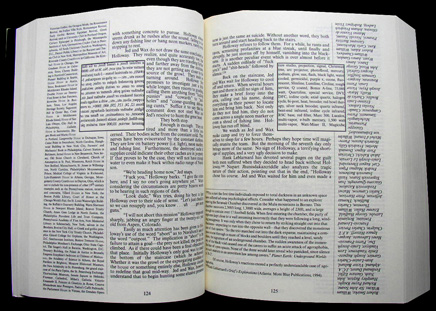
When people discuss this book, inevitably the novel's structure is one of the first things they talk about. And with good reason. Much like The Invention of Hugo Cabret used images to tell much of the narrative, so House of Leaves uses words to create images. Part of the reason why many people are reluctant to read this novel is because its sheer size is intimidating and because they see images like this:
Part of the chapter in which an expedition is launched inside the house to tackle the large spiral staircase that has grown within the dark and expansive interior, Danielewski uses footnotes in order to give the reader the impression that they too are walking down a never-ending staircase. Yet, for every page like this, there are pages like this:
Sitting on its side it doesn't look like much, but when you flip the book, it becomes a ladder of words, reflecting a ladder which one of the characters climbs in the book. There are even pages that have maybe one or two words on them, which means that for every page it takes you several minutes to read, there are entire sections of the book that you can get through in under a minute. But enough about the book's structure.
The plot itself is deep and interesting and the dizzying shifts between Zampanó's original text and Johnny Truant's footnote intrusions brings a uniqueness not found in other books. By making connections between the book and his own life, Truant subtly suggests to readers that there are connections to be made in their own lives. And there are. The characters that fill the pages of The Navidson Record are easy to relate to, which is quite a feat considering that their development is not constructed through a first person narrative like Johnny's but through a third person outside observer who shifts his focus from their troubles to anything from carbon dating to the story of Jacob and Esau.
Some have called House of Leaves a gimmick, but I prefer to see it as a refreshing break from the ordinary novel. Danielewski is a talented writer who uses both fact and fiction to create a terrifying story of family problems and personal struggles. This is not a story of monsters and boogeymen; it is far more chilling than that. House of Leaves is a book about how the extraordinary can either destroy a man or make him stronger. Just as it leaves the characters forever changed, it will leave the reader affected as well.
I'm giving House of Leaves 5 out of 5 Gabriels.
-Gabe
Labels:
big book,
book review,
fantasy,
fiction,
film,
horror,
psychological,
unconventional fiction
Wednesday, July 27, 2011
Film Review: Harry Potter and the Deathly Hallows, Part Two
After having to wait almost a full agonizing week to see this film, I finally went last Wednesday to experience what many are calling "the end of an era." While I can't say that I personally believe that the Harry Potter "era" is ending, I can admit that I was quite emotional throughout the entire film. I knew that this was the last time I would see a Potter film in theaters. I knew that it was, in a sense, the capstone to a journey that I had taken with a young wizard named Harry from the time I was in middle school. So, knowing that I'm a huge Harry Potter fan and knowing, also, that I wasn't a huge fan of the last book in the series, what, exactly, did I think of the film?
To quote Ron Weasley, it was "bloody brilliant." This review could be a blow-by-blow account of the film; it could be a comparison of the book and the film in minute, obnoxious detail. But it won't be. Instead, I want to talk about the things that stood out for me. There are probably hundreds of reviews of Deathly Hallows II on the internet, so if you're looking for something deeper, you've come to the wrong place. Here you will find only the highlights of what was a much more satisfying film than DH Part I.
1) Snape: I won't go digging around on my blog to find all of the times that I've talked about Snape, but those of you who regularly read my posts know that he comes up quite a lot. My favorite character since I first read Sorcerer's Stone, Snape has a special place in my black little heart. Alan Rickman has always been an actor that I highly admire, so the fact that I was always impressed by his portrayal of the surly potions master came as no surprise to me. What did surprise me, however, was how absolutely blown away I was with Rickman's performance in the last Harry Potter film. I wasn't a giant fan of the Snape/Lily storyline, but seeing how the flashback sequence was done in the film may just have changed my mind about it. Rickman is much more capable of portraying emotion and deep, anguished love than J.K. Rowling will ever be. I also want to thank the film's creators for taking out that whole bit where Harry blabs all of Snape's secrets to the whole world while he's fighting Voldemort.
2) Neville Longbottom: More so than Harry, Neville is a character that grew and changed over the course of the novels and the films. He goes from being a shy, scared young boy to being a strong man who is unafraid to stand up for what he believes in. The film did a fantastic job of showing this, especially when it came to the speech that Neville gives after Voldemort brings Harry's body back to the castle. Neville stands out in that scene as a sort of William Wallace. It's the kind of speech that would get a slow-clap-that-turns-into-thunderous-applause if this were a 90s teen movie. The only thing that really bothered me was the way in which Neville killing Nagini played out. It was supposed to be more dramatic because all of these people are trying and failing and because Ron and Hermione were being chased by the snake. It was supposed to put the audience on the edge of their seats going, "Oh my God, I wonder what's going to happen." Considering that most of the audience presumably knew what was going to happen, it just sort of dragged. At one point I started thinking, "Oh, no, don't tell me that they're not going to let Neville kill the snake." The only sigh of relief I breathed when he finally did was caused by knowing that now I wouldn't have to spend an entire blog post ranting about how Neville had been robbed of his spotlight.
3) Bellatrix Lestrange: While not usually a character that I really liked (or an actress, for that matter), I loved Helena Bonham Carter's scene with Ron and Harry at Gringott's. The absolute uncertainty that was written on her face, coupled with the tripping over her own shoes, made for a much better Polyjuice Potion scene than I had anticipated.
4) The humor: It was nice to see the dark tone of the film lightened by some really great comic moments, including the way Tom Felton's Draco tells Harry that his mother's wand "doesn't understand [him]." While some of the humor in the other films felt a little forced or flat, DH Part II used just the right amount and level of comic relief and the actors delivered the lines in an almost off-hand and very convincing way. It's been said that one of the greatest things about these films was that we as the audience have been able to see the actors grow and become more comfortable in their characters' skins. I think their timing and their delivery has improved ten-fold since the first film, which gave the film a much more authentic feel. These weren't actors; these were characters. I once heard Michael Caine say that he felt that if you were in a theater and you leaned over to your friend and said, "Isn't that Michael Caine a marvelous actor?" that he had failed at his job. You weren't supposed to see Michael Caine; you were supposed to see the person that Michael Caine was portraying. In this film, even more so than the rest, I saw the characters, rather than the actors.
There were, of course, some things about this film that I felt could have been better. Fred's death could have used a bit more screen time (and, I think, even a glimpse of Percy), the epilogue was still awful, and there were a few parts of the movie that I felt could have been shortened. Overwhelmingly, though, it was a spectacular end to the franchise. There are so many more things I could gush about--how kick-ass Minerva is, the fact that Neville and Luna may have gotten romantically involved after the battle, etc.--so I think it's safe to say that this was a great film and a decent adaptation of the book. It was, I think we can all admit, much more loyal to the text than, say, Half-Blood Prince.
-Gabe
Labels:
film,
Harry Potter
Friday, July 15, 2011
French Film: French Kiss (1995)
Okay, so this film isn't actually French, but it is set in Paris, so I'm counting it as a "French" film.
Year: 1995
Starring: Meg Ryan, Kevin Kline, Jean Reno
Plot: Kate (Meg Ryan), an American, flies to Paris in order to bring back her fiancé, Charlie (Timothy Hutton), who has fallen in love with the beautiful Juliette (Suzan Anbeh). On the flight from Canada to France, she meets Luc (Kevin Kline), a crook who, without Kate knowing it, stows a stolen necklace inside a plant and sticks it in her bag in order to get it through customs. When she disappears, he has to track her down, only to find that her bag has been stolen by a rival thief. Kate and Luc work together to find the necklace and join forces to try and break up Charlie and Juliette (who has a history with Luc). Along the way they find themselves developing feelings for one another.
Why You Should Watch It: I could explain this simply...as in, with only one sentence. You should watch this movie because I actually liked it. Now, I'm not saying that I'm an expert on film; I most certainly am not. What I mean is that this movie falls under two categories of things that I hate: chick flicks and films with Meg Ryan in them. Despite that fact, I found this film to be funny, charming, and all-around enjoyable. Why?
1) Meg Ryan and Kevin Kline have insanely good chemistry. Their journey to falling in love is both believable and fun to watch. They begin the film by despising each other and only grow to like each other after spending time together and seeing who the other person really is. I love films that develop relationships over time, instead of having characters fall (unrealistically) in love twelve seconds after they've met. I especially love it when it's done well. In French Kiss, the plot is paced well and the characters grow within that plot, both separately and as an eventual couple.
2) This film contains well-developed characters. A lot of films seem to disregard the fact that the audience is actually supposed to like the characters and identify with them. Kate, Luc, Charlie, Inspector Cardon (Jean Reno), and the others are not only likeable, they have personalities, back-stories, hopes, and fears. They have flaws and they are changed by the challenges that face them because of these flaws.
3) Kevin Kline and Jean Reno are always fun to watch. While Reno's character isn't a huge part of the main plot, his secondary story (trying to find Luc and the necklace) was threaded nicely throughout the film. Kline is insanely funny as a Frenchman and is probably the best reason to watch the movie. I've always admired his work, especially the comedic films he's done (A Fish Called Wanda is my all-time favorite Kline film), and he doesn't disappoint in French Kiss.
4) The script is great, especially considering this is a romantic comedy. Luc's lines are scene-stealers, but even Meg Ryan has some fantastic moments. My favorite exchange between the two of them has to be when they're discussing the man who stole her bag while speeding down a Parisian street in a car that Luc has stolen:
Luc: His name is Bub.
Kate: Bub?
Luc: Bub. Like, uh, Bub Dylan.
Kate: Oh, Bob!
Luc: (mockingly, in an exaggerated fake American accent) Oui, Baaaaaahhhhhhhb.It's a short, fun bit that really represents their whole relationship. You have the language and culture barrier, the snappy dialogue, the "I-don't-like-you-but-I'm-stuck-with-you" attitude. I won't go so far as to say that it's the funniest movie I've ever seen, but I give props to the writer, Adam Brooks, for the film's wit and authenticity.
I know there are some of you out there who really like rom-coms and/or Meg Ryan. For you, this movie is probably a no-brainer. For those of you who, like me, don't particularly like either of these things, I still highly recommend it. The script, the characters, the acting: all of it is well-done and makes for a great film.
-Gabe
Labels:
comedy,
film,
Francophone Friday,
French,
Paris in July
Francophone Friday 2
All this month, I'm participating in Paris in July, which means that I'll be reviewing some French novels, introducing you to French music, and just generally talking about all things French. Of course, this is a book blog first and foremost, so I wanted to make sure that my blog didn't get overwhelmed by French culture at the detriment of everything else. So, I'm implementing Francophone Fridays. It's the one day a week where I can let loose and ramble on and on about France (or in French). This is the day that you'll see links to French music, reviews of French films, information on culture in France, photos of French monuments, etc. The rest of the week will be devoid of anything Francophone. I think this keeps everything nice and tidy and keeps me from becoming an absolute bore.
Here's what I've been doing so far for Paris in July:
-Books:
Le Petit Prince by Antoine de Saint-Exupéry
Me Talk Pretty One Day by David Sedaris
-Music:
"Allo Paris" by Mano Solo
"Diane de Poitiers" by Thomas Fersen
-Film:
Le Dîner de Cons
Look for more posts later today.
-Gabe
Here's what I've been doing so far for Paris in July:
-Books:
Le Petit Prince by Antoine de Saint-Exupéry
Me Talk Pretty One Day by David Sedaris
-Music:
"Allo Paris" by Mano Solo
"Diane de Poitiers" by Thomas Fersen
-Film:
Le Dîner de Cons
Look for more posts later today.
-Gabe
Labels:
books,
film,
Francophone Friday,
French,
movies,
music,
Paris in July
Monday, July 11, 2011
When Film Gets It (Sort Of) Right: A Review of Stanley Kubrick's Clockwork Orange
Year: 1971
Starring: Malcolm McDowell
Plot: Based on Anthony Burgess' novel of the same name, A Clockwork Orange is the story of violent delinquent Alex and his three droogs. It's also the story of a corrupt government and the harmful ways in which it tries to combat crime. But mostly it's the story of a boy's transformation from criminal to reformed criminal and back again.
Challenges: Books to Movies Challenge
Anyway, even with the little nit-picky points that I could make (for example, why was the writer in a wheelchair and what was up with the oddly-shaped added character of Julian?), this is an insanely good film. It's terrifying, darkly funny, and trippy in a way that only Kubrick knows how to do. It also follows the novel pretty well, oftentimes taking the script directly from the novel. Alex remains as our "humble narrator" and very little is removed from the book for the film.
The cinematography is genius, with strange angles, chilling close-ups, and good use of space. Whoever designed the costumes and hair for the film was probably on acid, but in this case I think that it adds something to the film. It has a seventies' flavor without drawing too much attention to the fact that it was a film made in the seventies. Burgess' intention was to create a novel that would stand the test of time, one that wasn't bogged down by a slang or a setting that belonged too much to one era. I think Kubrick did a good job of keeping that idea intact while still giving his original audience a taste of their own time period.
The soundtrack is, I think, the most incredible aspect of the entire thing. Kubrick sprinkles in quite a bit of Alex's beloved Ludwig Van and throws in some other decent classical pieces as well. The music always fits the scene and it's played in such a way that it manages to be orchestral, synthetic, and creepy all at once. It sets the mood for the film, right from the beginning, just as much as the opening shot of Alex staring into the camera does. Brilliant film-making on Kubrick's part.
I wish that they had used more of the Nadsat that was used in the book, but I think audiences would reject the film if they had, especially those who have never read the book. It's much harder to immerse yourself in a slang that you aren't familiar with if you're watching it on screen than it is to do so if you're reading it in a book. Kubrick uses many of the words ("horrorshow," "kroovy," "rookers," etc.), but does so sparingly, sprinkling them throughout the film rather than using Nadsat as the primary means of communication for Alex and his droogs.
Obviously, there are some things in this film that might upset some people or trigger bad memories. The film, like the book, contains violence and rape, and I wouldn't recommend it if you're overly sensitive to these things. I would recommend it, however, whether or not you liked the book. Malcolm Macdowell is the perfect Alex and his performance is nothing short of amazing. He portrays Alex so close to the way that I pictured him in the novel and adds an even eerier delusional innocence to him than I could have imagined.
If I were reviewing this film simply as a film, I would give it a full five Gabriels. Since, however, I'm looking at it in conjunction with the novel, it gets only 4 out of 5. While the film is arguably one of the best movie adaptations of a novel ever, there are some things that could have been improved upon.
-Gabe
Labels:
dystopia,
film,
movie review,
science-fiction
Friday, July 8, 2011
French Film: Le Dîner de Cons (1998)
It's been several years since I've seen this film (which I watched for a French class in college), so this is less of a review of a film and more of a suggestion to watch said film.
Title: Le Dîner de Cons (The Dinner Game)
Year: 1998
Starring: Thierry Lhermitte, Jacques Villeret
Plot: Pierre and his group of friends host a dinner party every week to which each man invites a total stranger. This sounds like a nice gesture, but, in actuality, these dinners are a chance for them to humiliate people they think are ridiculous--men with strange hobbies or habits or people who are just plain stupid. Pierre plans on bringing François, a man he is sure will take the prize at the next "dîner de cons." But things don't go as planned when Pierre throws his back out and his wife leaves him and the only person around to help him is François. Soon Pierre is bombarded by crazy mistresses, possible tax audits, and a whole host of other problems as François' attempts to help only make things worse.
What makes the film really great, however, is the chemistry between Pierre and François. There's tension there because a) Pierre is in a lot of pain (both physically and emotionally) and François keeps making it worse and b) sweet, stupid François doesn't understand what he's doing wrong and keeps trying to make it up to a man he thinks is his friend. Throughout the film, Pierre comes to see his mistakes in life because they are laid bare to him by someone he thinks is a complete moron. It gives the story a soul that other comedies are lacking.
Why You Should Watch It in French: Obviously it's up to you if you watch it in French with subtitles or just watch an English dub. There's one joke, however, that I think works much better in French than in English. François accidentally calls Pierre's mistress, Marlène, whom Pierre has been attempting to cut out of his life...but he knows none of this. When he gets off the phone he tells Pierre that he's been talking to his sister. Pierre, who doesn't have a sister, is confused. When he informs François of this fact, the man insists the woman said that she was his sister. Pierre suddenly realizes what happened. Marlène's last name is Hissister. At least, in the English version it is. In the French version her name is Sasseur, which sounds like "sa soeur," which is French for "his sister." To me, Hissister is a crap last name and the joke loses some of its appeal because it's so obvious. In the French version, it's more subtle and it's funnier that François makes that mistake. In the English dub, it just comes off as being a weak attempt at being funny.
What About That Other Version?: Okay, so apparently America has to ruin everything foreign and this film is no exception. In 2010, a film called Dinner for Schmucks came out, starring Paul Rudd and Steve Carell, which is supposed to be a reboot of sorts. I've heard that it's absolutely awful and if you've seen it, don't let it keep you from watching Le Dîner de Cons. Personally, I haven't watched the atrociousness that is Schmucks, but I'm assuring you that Cons is a film you won't regret seeing.
-Gabe
Labels:
comedy,
film,
Francophone Friday,
French,
Paris in July
Wednesday, March 23, 2011
Terry Pratchett + Neil Gaiman + Terry Jones = ?
A Good Omens movie, that's what. Actually, according to this article that I found on Neil Gaiman's blog, it's a four part television series. I don't care what it is, I'm excited.
Fans of the book have heard rumors for ages that there would eventually be a film. There were apparently talks at one point to have Johnny Depp and Robin Williams play Crowley and Aziraphale (okay, yes to the first one and absolutely not to the second) in the possible-but-not-very-likely film adaptation. I'm not sure who will be cast in this version of it but I'm anxious to see it.
Terry Jones, of Monty Python fame, is scripting the adaptation along with Gavin Scott (whoever he is).
I'm sure that if this actually goes through you'll be hearing me gush about it in the future. Updates will be posted as they're made available.
-Gabe
| I wish I could be half as awesome as these guys. Terry Pratchett (left) and Neil Gaiman (right) |
Fans of the book have heard rumors for ages that there would eventually be a film. There were apparently talks at one point to have Johnny Depp and Robin Williams play Crowley and Aziraphale (okay, yes to the first one and absolutely not to the second) in the possible-but-not-very-likely film adaptation. I'm not sure who will be cast in this version of it but I'm anxious to see it.
Terry Jones, of Monty Python fame, is scripting the adaptation along with Gavin Scott (whoever he is).
| Terry Jones (left) learns all about flying sheep from Graham Chapman. |
I'm sure that if this actually goes through you'll be hearing me gush about it in the future. Updates will be posted as they're made available.
-Gabe
Subscribe to:
Posts (Atom)