Showing posts with label horror. Show all posts

Tuesday, January 27, 2015

Top Ten Tuesday: Top Ten Books I Would Love to Read with a Book Club (If I Had a Book Club)


I really need to find a book club at some point, but I haven't gotten around to it for some reason. There are tons of them in my area, so that isn't the problem. I think I'm just kind of picky and worry that I'll hate the books or the people. If I did have a book club, however, I'd want it to be a new and different type--reading horror or something instead of bestsellers. In fact, I think that's what I'll do. In the few years since I last blogged, I've become something of a horror fan and would love to have a group of people to discuss spooky reads with.

This week's Top Ten Tuesday topic:

Top Ten Six Books I Would Love to Read with My (Non-existent) Horror Book Club

1)  We Have Always Lived in the Castle by Shirley Jackson: I LOVED The Haunting of Hill House and have heard that this one is even better.

2) John Dies at the End by David Wong: I started reading this a while back and was really enjoying it, but life intervened. Having other people to read it with would be fun because it would be interesting to see everyone's reactions to the zany horror of this novel.

3, 4, & 5) The Passage, The Twelve, and The City of Mirrors by Justin Cronin: I've already read The Passage and City of Mirrors isn't going to be out until October of this year, but I think that reading the whole trilogy in one bite with a group of people would be awesome.

6) Eyes to See by Joseph Nassise: I bought this book in December of 2012 when I was still working at that seasonal bargain bookstore and I still haven't read it.

Okay, so there's only six. I really need to look and find more horror titles to put on a to-read list.

-Gabe

Sunday, January 18, 2015

[Review Request] Kicking Ass and Taking Names: A Review of Katherine McIntyre's Snatched


Title: Snatched
Edition: Jupiter Gardens Press (PDF, 2014)
Pages: 188
How I Came By This Book: This book was sent to me by the author. 


About the Author: Katherine McIntyre is an author of steampunk adventure, dark comedy, urban fantasy and paranormal romance stories. She splits her time writing and working the day job, but as for creative pursuits, she's dabbled in a little bit of everything. A modern day Renaissance-woman, she's learned soapmaking, beer brewing, tea blending and most recently roasting coffee. The one constant from a very young age was her passion for reading and writing. For more casual content, she’s a regular contributor on CaffeineCrew.com, a geek news website. With more imagination than she knows what to do with, writing proved to be the best outlet. (from GoodReads) Visit her website for more information.

Synopsis: When Kara was ten, the shifters took her parents.

A year ago, they took her best friend Hunter.

And now, the night before her first military strike against those monsters on the surface, the shifters take the only person she has left: her little sister Lizzy.

The snatched don’t come back. That’s what Kara’s believed her entire life, but the first person she finds above ground is the best friend she thought lost forever. Turns out, the higher ups lied. Other colonies are out there, hell even folks who toughed it up above. If anyone knows how to get her sister back, these people would. However, unless she can rally these surfacers into an army, one girl with a shotgun won’t survive long against the very creatures that overturned her world.

Review: Snatched came to me as review request from the author and, the night that she sent me the PDF, I read the first paragraph and went, "Dammit, I can't read this until I finish the book I'm currently on." With a highly-imaginative world; strong, relatable characters; and a huge talent for description, Katherine McIntyre's novel of a young woman trying to save her sister (while dealing with the fact that everything she'd ever known wasn't quite true) is a delightful and terrifying page-turner that will leave you wanting more of Kara Orris.

From the moment you step into the broken, post-apocalyptic world of Snatched, you leave your world behind, seeing what strong-willed Kara sees, feeling what she feels. McIntyre is a skilled author who delves deeply into the ethos of those who live underground: what they believe, what they value, how they view religion. I was struck by the spiritual aspect of the book and how unique it was compared to other similar novels. The tunnelers talk about the Great Spirit, the Phoenix, the Leviathan. Kara's mother was a shaman who used herbs and made her own incense. It was a refreshing change and one of the reasons I fell in love with this book so soon after starting it.

The characters in Snatched are likable, well-developed, and grow organically with the story. My favorites of these characters are Kara, a 17-year-old girl who has just returned from her first surface mission only to be thrust into a dangerous attack on the horrifying shifters; Jared, the stoic young soldier who has to reconcile what he learns on the surface with what his superiors have led him to believe; and Tweak, the surfacer girl of few words who helps the tunnelers navigate a world they've never known. In one particularly memorable (and genius) scene, the tunnelers encounter rain for the first time and freak the hell out. It was the first time in a while that I'd seen a believable reaction to an unknown stimulus and it really endeared me to the characters. Watching them react to the newness of everything was what made this book far more than just an adventure story.

All the same, however, it is an adventure--and a thrilling one at that. You know how when you watch an action or horror movie and you talk yell at the characters or wince when they get hurt, etc? This is the first book I've ever read that made me do that. My husband kept looking over at me and asking if I was all right because I would make noises of surprise or disappointment. One time I let out a big, "OH NO!" and he instantly asked me what was wrong. Of course, then he decided not to let me tell him because he wants to read it, too, so I had no one to share my despair with. 

This book provides an interesting twist on the Damsel in Distress trope, with the rescuer being a young woman and the "rescuee" being her younger sister. Watching Kara fight for her family and for what she wants was inspiring, even more so considering that she stayed very focused on her mission and didn't let herself get too embroiled in what could have, in another author's hands, been yet another ridiculous love triangle (or, square, in this case). Instead, Kara keeps her head on straight, her priorities in order, and her hormones in check. She is an exceptional young woman and I would love to see her in another novel in the future. 

I don't have many big complaints about the book. In fact, the only bit of constructive criticism I have is that, while McIntyre is great at creating a world and describing it completely and succinctly (no Tolkien-esque, long-winded descriptions in this book), she relies very heavily on similes. After a while, I found them to be a bit too frequent for my tastes. Other than that (and a few minor editing issues), I have nothing but praise for this book. 

I'm giving Snatched 5 out of 5 Gabriels AND I'm giving it the (NEW!) Gabriel Seal of Approval for its independent and totally role-model-worthy heroine.


-Gabe

PS: Check out my interview with Katherine McIntyre on Saturday, January 24!

Sunday, November 4, 2012

Charnel House No. 5: A Review of Patrick Suskind's Perfume: The Story of a Murderer


Title: Perfume: The Story of a Murderer
Author: Patrick Süskind
Edition: Hardcover (Alfred A. Knopf, 1986)
Pages: 255
How I Came by This Book: The copy that I actually read (a paperback that I bought at a library sale) is gone now, donated along with just short of 200 other books. The copy that I'm using for this review (almost a year after I originally read it) is a hardcover edition that my library had.


About the Author: Patrick Süskind was born in Ambach, near Munich, in 1949. After a problem with his hands made it impossible for him to pursue his ambitions as a concert pianist, Süskind enrolled in the University of Munich, where he studied medieval and modern history. His first play, The Double Bass, written in 1980, became an international success, performed in Germany, Switzerland, at the Edinburgh Festival, in London, and most recently at the New Theatre in Brooklyn. Mr. Süskind lives and writes in Munich.


Synopsis: The year is 1738; the place, Paris. A baby is born under a fish-monger's bloody table in a marketplace, and abandoned. Orphaned, passed over to the monks as a charity case, already there is something in the aura of the tiny infant that is unsettling. No one will look after him; he is somehow too demanding, and, even more disturbing, something is missing: as his wet nurse tries to explain, he doesn't smell the way babies should smell; indeed he has no smell at all.

Slowly, as we watch Jean-Baptiste Grenouille cling stubbornly to life, we begin to realize that a monster is growing before our eyes. With mounting unease, yet hypnotized, we see him explore his powers and their effect on the world around him. For this dark and sinister boy who has no smell himself possesses an absolute sense of smell, and with it he can read the world to discover the hidden truths that elude ordinary men. He can smell the very composition of objects, and their history, and where they have been; he has no need of the light, and darkness is not dark to him, because noting can mask the odors of the universe.

As he leaves childhood behind and comes to understand his terrible uniqueness, his obsession becomes the quest to identify, and then to isolate, the most perfect scent of all, the scent of life itself.

At first, he hones his powers, learning the ancient arts of perfume-making until the exquisite fragrances he creates are the rage of Paris, and indeed Europe. Then, secure in his mastery of these means to an end, he withdraws into a strange and agonized solitude, waiting, dreaming, until the morning when wakes, ready to embark on his monstrous quest: to find and extract from the most perfect living creatures--the most beautiful young virgins in the land--that ultimate perfume which alone can finally make him, too, fully human. As his trail leads him, at an ever-quickening pace, from his savage exile to the shores of the Mediterranean and then back to Paris, we are caught up in a rising storm of terror and mortal sensual conquest until the frenzy of his final triumph explodes in all its horrifying consequences.

Told with dazzling narrative brilliance and the haunting power of a grown-up fairy tale, Perfume marks the debut in English of a most remarkable novelist.

Review: Sometimes I feel like blurb writers are wanna-be book reviewers. Hell, maybe they are all book reviewers in their spare time. I don't really know. All I know is that sometimes the synopses given on book covers are like books themselves. They leave people like me wondering what exactly I should say that hasn't been said. I mean, look at that. That's a pretty decent retelling of, you know, everything that happened in the book. Sure, there are details missing, but the basics are all there. I hate just jumping into a review without at least saying something about it as an introduction. Now I'm not sure what to say. It'll probably pale in comparison to that blurb up there.

Let me try to sum all of that up:

There's a man named Jean-Baptiste who has no scent of his own but who can recognize the smell of everything. Fish. People. Doorknobs. Lock him in a dark room and hold up a dinglehopper and he'd be able to tell you what it was, who had used it, and what the person in the room next door had eaten for lunch three days ago without even breaking a sweat.

Not pictured: a creepy Frenchman who can smell what's in your liver.

He comes to realize that because he has no scent, people are creeped out by him (although if you ask me, there's quite a lot about Jean-Baptiste that's pretty freaky). He spends a good portion of his life working for perfumeries and honing his skills so that he can make essence of dirt or puppy dog or poop or virginal beauty in order to eventually reach his goal of finding a scent that he can wear to make him feel like a human. On the way he kills a bunch of women and bottles their scents. Yeah, it's that kind of novel.

I loved the uniqueness of this book. Our main character is a man so reprehensible and sketchy that you hate him and yet you can't help but want to know what happens to him. Süskind's writing is superb, which could also be attributed to the translation, although after a while the description of different scents drags on and on. And on. The plot is unlike anything I've ever read and, while I didn't like the ending or the slower bits, the story was so new and daring that I ended up loving the book as a whole.

Perfume is highly disturbing. Jean-Baptiste has no soul, no remorse. He is a merciless killer who values odors more than people. Parts of the book were absolutely disgusting and there's nothing redeeming about the main character to lessen the blow. This is not a happy book. From beginning to end, the reader is thrust into a dark world where anger, disgust, and an amoral passion for killing are driving forces behind the actions of the protagonist. Some people might not be able to get through the book; those who do will be torn between loving the quality of the novel and hating the character and his actions.

I'm giving Perfume: The Story of a Murderer four out of five Gabriels. There were a lot of descriptive passages about perfumes that got a bit boring after a while and I didn't like some of the elements of the plot (namely, his period of solitude and the ending). If you're looking for a dark and strangely different read, this book is highly recommended.


-Gabe

Tuesday, October 23, 2012

Top Ten Tuesday

Top Ten Tuesday is hosted by the girls over at The Broke and the Bookish. Every week they post a prompt and ask book bloggers to answer that prompt in the form of a top ten list.

This week's prompt is: Top Ten Books to Get in the Halloween Spirit

I answered a very similar prompt last year called Top Ten Books to Read During Halloween. I haven't read anything since then because, frankly, I don't know enough about horror and have never gotten into the genre.

This week, I'm doing things a little differently. I'm letting you, dear reader, create my Top Ten List for me. In addition to any book recommendations that are left in the comments, I'll be looking through your Top Ten Lists to construct a list of Top Ten Horror Novels Gabe Should Read Before Next Halloween.

Check back here later in the day to see what books I've chosen. And don't forget to leave your favorite horror novel suggestions in the comments!

-Gabe

Wednesday, November 9, 2011

Red Riding Hood and Goldilocks Walk into a Bar: Reviews of Grimm ("Pilot" and "Bears Will Be Bears")


Title: Grimm
Airs: Fridays at 9 on NBC
Starring: David Giuntoli, Russell Hornsby, Silas Weir Mitchell

Contrary to what you might believe given the post I wrote back in March about some of my favorite shows, I don't actually watch television much. Or, really, at all. There are some shows that I got into while they were on television (the now-gone Alias, Jericho, and Stargate Universe and the still-running Big Bang Theory), but normally the shows that I get into are already cancelled and I just watch them on DVD (Battlestar Galactica, Stargate SG-1, Stargate Atlantis, The 4400). It saves me the trouble of having to wait a full week to see the next episode and, more importantly, it ensures that I don't have to be bombarded by mind-numbing and increasingly idiotic advertisements. I'm really picky when it comes to which shows I'll even give half a chance to and, as you can probably tell, the ones I end up liking tend to be sci-fi related.

When I heard that Robert Carlyle (The Fully Monty, Trainspotting, Stargate Universe) was going to be in a new television show I was curious to see what it would be like. I'm a huge fan of his work and I had heard that it was a fairy-tale related show, which piqued my interest. So, when someone mentioned that the show Grimm was going to be debuting the Friday before Halloween, I thought, "Hey, that must be the show, right?" It wasn't. Turns out that he's on ABC's Once Upon A Time, which I didn't realize until after I watched the second episode of Grimm. While I haven't seen the ABC take on fairy tales yet, I got hooked on NBC's within the first half of Grimm's pilot episode.

Given that this is a book blog and Grimm is a bookish television show, I've decided that I'll be reviewing the show on a weekly basis. It may not get posted the next day but it'll generally be sometime before the next episode airs. Today, you get a two-for-one deal because I didn't think about it until I was rewatching the episodes on Sunday night (thank you, NBC.com!).

Without further ado, here's my thoughts on the first two episodes of Grimm.

Warning: possible spoilers ahead.

"Pilot" (first aired October 28, 2011)

Plot: On the same day that his Aunt Marie (Kate Burton) comes for an unexpected visit, Nick Burkhardt (David Giuntoli) starts seeing people in a whole new light--literally. He's one of the last of the Grimm family and it's his gift (or curse) to see the creatures that haunt the folk tales and fairy stories of old. The brutal murder of a college student and the disappearance of a little girl (both wearing red hoodies) lead him to Eddie Monroe (Silas Weir Mitchell), a big bad wolf who's not so big and bad. Nick and Eddie work together to try and find the killer before he claims his next victim.


Review: I had gotten sick of police shows a long time ago. It doesn't matter if they get dressed up with fancy lighting or glitzy locales, they're all basically the same show rehashed over and over again. Grimm is nothing like these shows. It's not just that the criminals are supernatural beings; Grimm is a serial rather than a procedural and it has interesting characters and a good sense of humor in addition to its creepy atmosphere and fun twists on old stories.

This retelling of "Little Red Riding Hood" used its material well while still doing something new and fun. The juxtaposition of an age-old tale in a modern world reminds me a lot of The 10th Kingdom (a mini-series that was on NBC over a decade ago) but it's a lot scarier and a lot grittier. The episode started with a murder and continued to get more intense from there. The pace was good, with no real lulls in the action, and with an interesting way of using exposition. In the scene where Marie first starts to tell Nick about his family they get attacked by a creature called a Reaper. Definitely preferable to people just sitting around talking.

The characters, though, were what brought me back in front of the TV the next week, especially Mitchell's character, Eddie. Afterward, I had a short discussion on Twitter with someone who had said that the humor was a bit much for a show like Grimm and could be toned down, but I disagree. I think the humor, especially Eddie's, is what really sets this show apart from other cop shows, where everyone's so depressed and no one smiles. The partnership between Nick and Hank (Hornsby) is also fun to watch, although it's pretty similar to other cop partnerships out there. I much prefer the begrudging friendship that develops between Nick and Eddie. Eddie's reluctance to help Nick stems from the fact that his parents used to tell him stories about the Grimms and they "scared the hell" out of him and because (as we find out in the second episode) his family has a history of run-ins with the Grimms that never ended well. They're both fish out of water, really, and I like the idea of watching these characters develop as the season goes on.


I can't really find anything major to complain about for this episode. While the special effects aren't spectacular, they aren't horribly bad either, and everything else worked really well. The writing was good, the acting was good, and the story was engaging. I don't have a rating system for films or television shows worked out just yet, but the pilot episode of Grimm would most likely get the top grade.

_______

"Bears Will Be Bears" (first aired November 4, 2011)

Plot: A young couple, Gilda and Rocky, break into the home of an affluent family only to get more than they bargained for when Rocky gets attacked and Gilda barely gets away. Nick and Hank search for him while Eddie gets stuck standing guard over Nick's dying aunt--a woman whose family has a history of killing Eddie's  ancestors.


Review: Each episode of Grimm starts out with a quote that helps the audience guess which story will be incorporated into the plot that evening. This time it was "Goldilocks and the Three Bears" and it was just as interesting a retelling as the first episode's version of "Red Riding Hood" had been. The regular characters from last week were back but they were joined by not only Gilda and Rocky but by the Rabe family...who aren't all that they seem.

This episode was great but I liked it better the second time around than I did the first. A lot of people who were talking about it on Twitter afterwards said that it was even better than the pilot, but I needed a rewatch to fully appreciate it, I think. There was a lot that went into "Bears Will Be Bears," which continued the thread of last week's episode while introducing a new case into the mix. Much like a lot of the other shows that I've loved, Grimm isn't episodic, which I like because I feel serialized shows are able to get more in-depth and are more likely to draw you in the following week because of a cliff-hanger or some other hook. This episode ended with one just like the first did and I'm already anxious to see Friday's episode.


I like Nick's character, but he's sort of a blank slate. We don't know a whole lot about him just yet (or his, to me, suspicious girlfriend), so I'm looking forward to being able to fill in the gaps. We find out a little more about Eddie and a little more about Hank, both of whom have become my two favorite characters (in that order). If they'd just build Nick up a bit more than these two he could be a really strong character but so far I think he pales in comparison to them...even though the show is about him.

Again, the special effects aren't fantastic, but I'm okay with that. I don't need the best CGI to enjoy something. If you compare, say, the original Star Wars trilogy to the crappy new Star Wars films, the originals were so much better because they focused more on creating amazing characters and exciting plots than they did creating a bunch of awe-inspiring special effects. I would take compelling show over technologically-advanced show any day.

And Grimm is compelling. You're always wondering what will happen next and very often you're surprised by what you find. Even though I swore I would never get addicted to a TV show again, Grimm has become my once-a-week fix. All it really needs is to develop the main character more and to keep Eddie's humor at its current level. I could tell that the second episode had toned him down a bit and, while I'm okay with that, any more toned down and he won't be the character I've already grown attached to.

Again, I don't have a rating system figured out yet (it's coming), but if I did, "Bears Will Be Bears" would be pretty high up the scale.

For those who haven't watched the show but are curious about it, you can watch the first two episodes on NBC's Grimm site. It's enough of a miracle that I'm watching a television show, but that I'm this enthralled with it means they've gotta be doing something right.

-Gabe

Monday, October 31, 2011

Abandon All Hope, Ye Who Enter Here: A Review of House of Leaves by Mark Z. Danielewski

Happy Halloween, everyone! And to my Pagan followers, Blessed Samhain!


Title: House of Leaves
Author: Mark Z. Danielewski
Edition: Paperback; 2-Color (house appears in blue)
Publisher: Pantheon Books (2000)
Pages: 709
Challenges: Read Me Baby, One More Time; GoodReads 2011 Reading Challenge
How I Came by This Book: The first time I read House of Leaves, I borrowed my friend Amanda's full-color copy, after both she and one of my exes (neither of whom have ever met the other and who are as different as night and day) recommended it to me. The copy I read this time is my own, which was given to me by a friend who had gotten it from a friend.


About the Author: Mark Z. Danielewski is an American author. He is the son of Polish avant-garde film director Tad Danielewski and the brother of singer and songwriter Annie Decatur Danielewski, a.k.a. Poe.

Danielewski studied English Literature at Yale. He then decided to move to Berkeley, California, where he took a summer program in Latin at the University of California, Berkeley. He also spent time in Paris, preoccupied mostly with writing.

In the early 1990s, he pursued graduate studies at the USC School of Cinema-Television. He later served as an assistant editor and worked on sound for Derrida, a documentary based on the life of the Algerian-born French literary critic and philosopher Jacques Derrida.

House of Leaves, Danielewski's first novel, has gained a considerable cult following. His second novel, Only Revolutions, was released in 2006. Though released to less critical acclaim than his debut, the novel was a finalist for the 2006 National Book Award. Danielewski's work is characterized by experimental choices in form, such as intricate and multi-layered narratives, typographical variation, and inconsistent page layouts.

In 2000, Danielewski toured with his sister across America at Borders Books and Music locations, promoting Poe’s album Haunted, which reflects elements of House of Leaves. (from GoodReads) 


Synopsis: Years ago, when House of Leaves was first being passed around, it was nothing more than a badly bundled heap of paper, parts of which would occasionally surface on the Internet. No one could have anticipated the small but devoted following this terrifying story would soon command. Starting with an old assortment of marginalized youth--musicians, tattoo artists, programmers, strippers, environmentalists, and adrenaline junkies--the book eventually made its way into the hands of the older generations, who not only found themselves in those strangely arranged pages but also discovered a way back into the lives of their estranged children.

No, for the first time, this astonishing novel is made available in book form, complete with the original colored words, vertical footnotes, and newly added second and third appendices.

The story remains unchanged, focusing on a young family that moves into a small home on Ash Tree Lane where they discover something terribly wrong: their house is bigger on the inside than it is on the outside. 

Of course, neither Pulitzer Prize-winning photojournalist Will Navidson nor his companion Karen Green was prepared to face the consequences of that impossibility, until the day their two little children wandered off and their voices eerily began to return another story--of creature darkness, of an ever-growing abyss behind a closet door, and of that unholy growl which soon enough would tear through their walls and consume all of their dreams. 


Review: People have said a lot of things about House of Leaves, but one descriptor that comes up over and over again is, if you'll pardon my French, "mind-fuck." This book is exactly that. A psychological novel that explores the unknown nature of darkness and the toll that it can take on the human mind, House of Leaves has the distinction of being one of those books that, as clichéd as it sounds, I'd dub "life-altering." Despite the fact that I'm a night owl and that I'm not easily spooked, after reading this book the first time, I looked at closets and dark corners with trepidation for months. In addition to this new-found (but temporary) uneasiness, I found that this book also changed my perceptions of insanity, loneliness, and, yes, the usefulness of footnotes.

The book tells a three-fold story. The main narrative is about Will Navidson, Karen Green, and their new home on Ash Tree Lane. Shortly after moving in they discover that the dimensions of the inside of their house are bigger than those of the outside. The secondary narrative is that of Johnny Truant, a drug-addled young man who finds and assembles the manuscript of a scholarly book written about a non-existent film about the house, titled The Navidson Record, after his friend's neighbor, Zampanó, dies. The tertiary narrative surrounds the late Zampanó and is inextricably linked with both The Navidson Record and Johnny Truant's story. I think it's safe to say that already you can tell that this is a riddle wrapped in a mystery inside an enigma. What Danielewski/Zampanó/Johnny Truant do with this riddle is even more impressive.

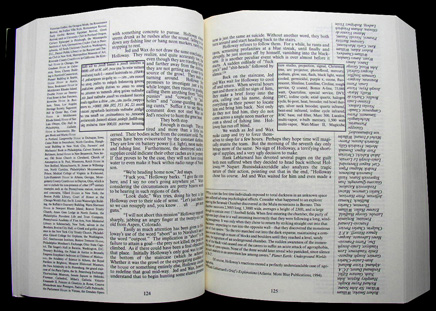
When people discuss this book, inevitably the novel's structure is one of the first things they talk about. And with good reason. Much like The Invention of Hugo Cabret used images to tell much of the narrative, so House of Leaves uses words to create images. Part of the reason why many people are reluctant to read this novel is because its sheer size is intimidating and because they see images like this:


Part of the chapter in which an expedition is launched inside the house to tackle the large spiral staircase that has grown within the dark and expansive interior, Danielewski uses footnotes in order to give the reader the impression that they too are walking down a never-ending staircase. Yet, for every page like this, there are pages like this:


Sitting on its side it doesn't look like much, but when you flip the book, it becomes a ladder of words, reflecting a ladder which one of the characters climbs in the book. There are even pages that have maybe one or two words on them, which means that for every page it takes you several minutes to read, there are entire sections of the book that you can get through in under a minute. But enough about the book's structure.

The plot itself is deep and interesting and the dizzying shifts between Zampanó's original text and Johnny Truant's footnote intrusions brings a uniqueness not found in other books. By making connections between the book and his own life, Truant subtly suggests to readers that there are connections to be made in their own lives. And there are. The characters that fill the pages of The Navidson Record are easy to relate to, which is quite a feat considering that their development is not constructed through a first person narrative like Johnny's but through a third person outside observer who shifts his focus from their troubles to anything from carbon dating to the story of Jacob and Esau.

Some have called House of Leaves a gimmick, but I prefer to see it as a refreshing break from the ordinary novel. Danielewski is a talented writer who uses both fact and fiction to create a terrifying story of family problems and personal struggles. This is not a story of monsters and boogeymen; it is far more chilling than that. House of Leaves is a book about how the extraordinary can either destroy a man or make him stronger. Just as it leaves the characters forever changed, it will leave the reader affected as well.

I'm giving House of Leaves 5 out of 5 Gabriels.


-Gabe

Thursday, October 20, 2011

Not Exactly Waterfront Property: A Review of The Haunting of Hill House by Shirley Jackson

NOTE: This is actually not my original review of this book, but it's as close as I could get. The first review (which was perfect in every sense of the word) was eaten by Word despite the fact that I was positive that I had saved my work before the program crashed. Needless to say, I was not a happy man. But, here's what I was able to recreate. It's not quite how I wanted it, but I couldn't remember everything exactly as I had written it.


Title: The Haunting of Hill House (in Novels and Stories compiled by Joyce Carol Oates)
Author: Shirley Jackson
Edition: Hardcover
Publisher: Library of America (2010)
Pages: 174 (p. 243-417)
Challenges: 2011 GoodReads Reading Challenge
How I Came by This Book: It’s October, which is the only month that I really get a craving for spooky stories. As horror isn’t a genre that I delve into on a regular basis, I had no idea what to read. This book turned up in an internet search and the synopsis sounded intriguing, so I checked it out of my library.

This is the one picture of her I could find that didn't look eerily like my mother.

About the Author: Shirley Jackson was an influential American author. A popular writer in her time, her work has received increasing attention from literary critics in recent years. She has influenced such writers as Stephen King, Nigel Kneale, and Richard Matheson.

She is best known for her dystopian short story, "The Lottery" (1948), which suggests there is a deeply unsettling underside to bucolic, smalltown America. In her critical biography of Shirley Jackson, Lenemaja Friedman notes that when Shirley Jackson's story "The Lottery" was published in the June 28, 1948, issue of The New Yorker, it received a response that "no New Yorker story had ever received." Hundreds of letters poured in that were characterized by, as Jackson put it, "bewilderment, speculation and old-fashioned abuse." (from GoodReads)

Synopsis: First published in 1959, Shirley Jackson's The Haunting of Hill House has been hailed as a perfect work of unnerving terror. It is the story of four seekers who arrive at a notoriously unfriendly pile called Hill House: Dr. Montague, an occult scholar looking for solid evidence of a "haunting"; Theodora, his lighthearted assistant; Eleanor, a friendless, fragile young woman well acquainted with poltergeists; and Luke, the future heir of Hill House. At first, their stay seems destined to be merely a spooky encounter with inexplicable phenomena. But Hill House is gathering its powers-and soon it will choose one of them to make its own. (from GoodReads)

Review: My first taste of Shirley Jackson’s work was her controversial short story, “The Lottery.” For those of you haven’t read it, I won’t give anything away, but I will admit to vehemently disliking it and vowing never to read anything else she had written. Fortunately, that was ten years ago and I have learned over time that one disliked story should never deter you from reading other things an author has written. The Haunting of Hill House made me glad that I decided to leave my high school grudge behind. This book is incredible.

The basic premise is that four strangers are spending the summer at Hill House in order to observe supernatural phenomena. The house has gotten a reputation over the years, mostly because anyone who moves into it ends up leaving soon afterwards. The book follows the four main characters over the course of the summer and what happens to them at Hill House. There’s Eleanor, the 32-year-old woman who has spent the better part of her life looking after her ailing mother and who is only just now getting her first taste of freedom after the woman’s death; Theodora, an eccentric woman who enjoys antiques and who lives with (presumably) her female lover (referred to only as her “friend”); Luke, the nephew of the current owner of Hill house who is “a liar…[and] also a thief;” and Dr. Montague, the man who brings them all together by writing them a vague but inviting letter asking if they would care to join him for the summer.

If this novel is any indication of the rest of Jackson’s work, she is immensely talented at creating a mood. The book is at times warm and inviting and at others it is cold and forbidding. She chooses her words carefully in order to express just what the characters are feeling and, in doing so, these feelings transfer to the reader. Her vivid descriptions sink the reader into the story so that it no longer feels as if he is reading about things happening to other people; they are happening to him as well. It isn’t just that she creates images of the house and of its inhabitants. The reader experiences everything as if it’s in real time. It reminded me a lot of the “feely” movies from Brave New World—it was as if I was watching a movie but at the same time feeling every shaking of the house, every cold chill, every indication that something was not quite right.

The characters that Jackson creates are instantly likeable…and then become less so as the novel progresses. It isn’t that they are bad people or that they are poorly-crafted. On the contrary—these characters are deep and relatable. Instead, it’s that the longer they stay in the house, the more they become a part of it. Jackson knows exactly how to develop these characters based on their relationships with each other and with Hill House. It isn’t until Mrs. Montague, the professor’s wife, comes for a visit towards the end of the book that you realize that something else has happened as well. When I was reading the book, I thought I disliked her simply because she was obnoxious (which she is). The more that I think about it, however, the more I realize that it’s because she’s an outsider. She just doesn’t understand what the characters have been through…what I had been through. Because it isn’t only the characters that change throughout the course of the novel; it’s the reader as well. By the end of the book I, too, had become part of Hill House and Hill House had become a part of me. You become so immersed in this book that the actions of those characters that haven’t been on this transformative journey with you seem incomprehensible, silly, and, even, dangerous.

Although told in third person, we see the majority of the novel’s action through the eyes of Eleanor. She’s a character that you really feel for at first: lonely, naïve, sad, self-conscious. The direction her character takes during the novel is the most drastic of the four characters, but none of them come out of their experience unscathed. By the time you close the book, your opinions of all of them will have changed (for better or worse), but it is important that this happens. Jackson is telling a story not of triumph but of terror, a story of the deleterious effects that fear and paranoia can have on a human being. The psychological aspects of this story make it all the more terrifying because the ghouls that haunt this house aren’t visible; the unknown nature of who they are and what they want is scarier than any slasher film or monster movie.

The Haunting of Hill House is an insanely good novel. From her use of foreshadowing to her carefully-crafted bump-in-the-night moments to the fact that you come to feel as if you are a fifth main character, I loved everything about it. Anyone looking for a good spooky read this Halloween will find it between the covers of this Jackson masterpiece.

I’m giving The Haunting of Hill House 5 out of 5 Gabriels.


When I was in fifth or sixth grade I heard the song below on A Prairie Home Companion and, even though the house in the song isn't actually haunted, it kept going through my head as I was reading this book. It has the right sort of mood and some, pardon the pun, haunting vocals. 


-Gabe

Tuesday, June 21, 2011

Cthulhu and Sherlock and Shadow; Oh My!: A Review of Neil Gaiman's Fragile Things


Title: Fragile Things
Author: Neil Gaiman
Edition: Paperback
Publisher: Harper (2006)
Pages: 363
How I Came By This Book: I picked this up at Barnes and Noble a few months ago in my continued attempt to own and read everything ever written by this man.
Challenges: Read Your Own Books Challenge; GoodReads 2011 Reading Challenge

Synopsis: A mysterious circus terrifies an audience for one extraordinary performance before disappearing into the night. Two teenage boys crash a party and meet the girls of their dreams--and nightmares. In a Hugo Award-winning story, a great detective must solve a most unsettling royal murder in a strangely altered Victorian England.

These marvelous creations and more showcase the unparalleled invention and storytelling brilliance--and the terrifyingly dark and entertaining wit--of the incomparable Neil Gaiman. By turns delightful, disturbing, and diverting, Fragile Things is a gift of literary enchantment from one of the the most original writers of our time.

Review: Gaiman's first book of short stories, Smoke and Mirrors, got me interested in the genre in a way I had never been before. While Fragile Things is an impressive batch of tales, I found that I didn't like it quite as much as I did the other.

Obviously these stories are well-written, funny, dark, terrifying, and wonderful all at the same time. Even when I'm not fully impressed with Gaiman (see The Graveyard Book), I still cannot deny that he is a) one of the greatest living writers and b) my favorite contemporary author. These stories are everything that I've come to expect from him and, as an American Gods lover, I appreciated the added bonus of a novella featuring Shadow, the main character from Gaiman's novel of gods and men. Many of these stories were enjoyable, but I felt they lacked a certain something that the stories in Smoke and Mirrors had...I just can't put my finger on what it is. We'll just call it that je ne sais quoi (I don't know what).

Some of my favorite stories from this collection include the aforementioned novella ("Monarch of the Glen"), the brilliant Sherlock Holmes/Cthulhu mash-up ("A Study in Emerald"), the Gothic satire "Forbidden Brides of the Faceless Slaves in the Secret House of the Night of Dread Desire" (which also has the best title ever), and the Matrix-inspired "Goliath." Two of Gaiman's best poems are also featured in Fragile Things: "Instructions" and "The Day the Saucers Came."

Here's a video of Gaiman himself reading "Instructions:"


And the best animated version of "The Day the Saucers Came:"


Whereas all of the stories in Smoke and Mirrors kept me interested, there were several stories here that got my mind wandering a bit. I'm going to be fair here and remind everyone that this was the second book that I read during the read-a-thon this past weekend so this could have had something to do with it...although I doubt it. Nothing really stood out to me, like "We Can Get Them for You Wholesale" or "Murder Mysteries" did in Smoke and Mirrors.  "Forbidden Brides" comes close but I didn't fully enjoy it until I had reached the end of it and realized that the whole idea behind the story was that what was going on the whole time was normal. (To understand what I mean, you'll have to read the story. When you get to the last few pages the whole thing becomes a LOT funnier than it originally seems.)

I even found the American Gods novella to be a bit lacking. I loved revisiting Shadow and I love that the story took place in Scotland, but I'm not a huge fan of Smith or Mr. Alice, so their inclusion in that story sort of threw it for me. I also felt that Shadow wasn't quite the same as he had been at the end of American Gods, that the character had lost something. It was a great story, it just didn't fully do it for me.

All in all, this was a good book, especially the poems, which Gaiman has said some people didn't like in either book. I'm not a fan of poetry, but I love the way that Gaiman plays with words, rhythm, rhyme, and different poetry styles. These are poems that I could read over and over and not get sick of. I will say that Smoke and Mirrors is superior in terms of its short stories, but I would read Fragile Things again.

I'm giving Smoke and Mirrors 4 out of 5 Gabriels.


-Gabe