Showing posts with label fantasy. Show all posts

Thursday, January 29, 2015

Author Interview: Donald Schlaich


How about we start out by having you introduce yourself? Tell us a bit about who you are.
My name is Donald Schlaich, and I'm a graphics arts professional and aspiring author. I've finished and self-published my first novel, Reckless Magus, and am working on the edits for the sequel, Dragon Magus.

I'm a geek who's been a fan of fantasy my entire life, and who underwent a kind of revelation when I discovered Terry Pratchett in Highschool. I'm also an avid biker, who sometimes regrets living in a city that gets ten feet of snow a year.

Where did the impetus to write come from? 
I've woven stories in my head for as long as I can remember, and when I was young, I can probably say I might have lost at least one job to living partially in daydreams as I went about my work. The stories have been a part of who I am for so long, and once I actually started putting them on paper, I found it hard to stop.

Explain who Abe Spellchaser is and how he came to be.
Abraxas "Abe" Spellchaser is an apprentice Magician, someone who has the potential to understand and use every type of magic. He's been trained by his father since he was ten years old in the use of his magic, including walking between worlds. He's confident in his knowledge, but he's mostly book-taught in his magic, and he's been stranded without any of his notes in a place where magic doesn't work according to rules he had written down. In place of his notes, he's left with his inquisitive nature and a tendency to get himself into trouble.

Abraxas Spellchaser is also a character I played several years ago in a Dungeons and Dragons game. I lived inside his head for a couple of years as I played him, and the first real long-form writing I did was recording the story of the game we were playing at the time.

How did you go about creating the universe in Reckless Magus?
I started with the characters of Abraxas and Simon, two characters who I already had a strong handle on, along with the history of Abe's father Nerick. There are bits of this universe that have been growing in my head for almost fifteen years, and once I had the two characters who the first story would center on, the rest of the world started to come together.

Magic features very heavily in the novel. Explain how the magic in your books works.
There are many different disciplines of magic, of which the first book only highlights a few. Not everyone has the talent to use every type of magic, and those who focus on a given type of magic often are referred to by their primary discipline.
* Mental magic, the ability to speak mind-to-mind, edit another person's memories, or even restructure their whole thinking process. Those who are skilled in this type of magic are typically referred to as Espers.
* Spirit magic is the one I've had some of the most fun figuring out and expanding upon. It's specialists are called shamans, and they specialize in the ability to reach across the boundary between waking and sleep to reach the creatures that live in the Dream Lands, a place made of spiritual energy, and making deals with them. In the universe of the Spellchaser Chronicles, this is probably the most common discipline, since even a minor talent in this area is required to be able to dream.
* Energy manipulation, the creation of light and energy, and the binding of that to an object, and it's specialists are called Illuminators.
* Travel magic, the ability to open doors and bend space to get from here to there. This discipline is the one Abe probably had the most practice with, and the one he most regrets not being able to use throughout the first book.
* Magicians are those who have the ability to use each discipline of magic, though their talents may vary in terms of strength and how much they've practiced with any given discipline.

There are several more disciplines, but I feel like going too much farther is probably a spoiler for future books.

Who is your favorite character? Who is your least favorite character?
I think my favorite character in the first book is Ari, a thief who Abe partners with. Ari is a person who goes through life with a laugh, never taking anything too seriously, and it's fun just watching him go to work in a scene.

I'm not sure if I have a least favorite character; I think to best write people you have to at least like them enough to understand what's going on in their head. I have characters I love to hate, like Jacob, an Esper who works against Abe and Simon because of his own worries and feelings of inadequacy.

If Abe's adventures were made into a movie, who would you like to see cast in which roles?
I would love to see the Spellchaser Chronicles made into a movie, though I've never taken time to go out and character board what I'd like everyone to look at. Maybe Luke Youngblood, but that may just be reaching out for a solid actor from a show I'm watching right now (Galavant's Sid).

What's next for Abe and his companions?
Abe's next adventure is in the editing phase, and there's an element of traditional sword and sorcery to his life: where he goes, trouble either follows or was already getting ready to throw it's coming out party when he arrives.

What are some things you'd like to write that aren't in the Spellchaser universe?
I've got a couple of other fantasy stories that I'm going to spend some time on once I'm done with Dragon Magus. After I finish those, I'm not sure what comes next. I may spend a bit of time world building, and see what my beta readers enjoy me fleshing out.

Why did you decide to publish your book the way you did and what has your experience been? Would you recommend it to other authors?
I self-published Reckless Magus, and some of the reason is that I figured I had the kind of skills I needed to do that from my day job. I wasn't completely right, but it's been a wonderful learning experience.

I also wanted to self-publish because there's a way in which I like the independence offered by self-publishing. I wasn't paid any small advance that my book had to earn back before I saw the long-term profits, but instead it's been a slow trickle of sales, and the size of that trickle is somewhat my fault. I got caught up in the other parts of my life and haven't been pushing Abe's story as much as I should have. 

What advice do you have for new writers?
Write. Keep going and just write. It's a muscle that you build the more that you do it, so exercise that muscle. And let your first draft suck. It's a common bit of advice you hear, but that's because it's true. Write when you're writing the story, and leave the editing for after you're done.


-Gabe

Sunday, January 18, 2015

[Review Request] Kicking Ass and Taking Names: A Review of Katherine McIntyre's Snatched


Title: Snatched
Edition: Jupiter Gardens Press (PDF, 2014)
Pages: 188
How I Came By This Book: This book was sent to me by the author. 


About the Author: Katherine McIntyre is an author of steampunk adventure, dark comedy, urban fantasy and paranormal romance stories. She splits her time writing and working the day job, but as for creative pursuits, she's dabbled in a little bit of everything. A modern day Renaissance-woman, she's learned soapmaking, beer brewing, tea blending and most recently roasting coffee. The one constant from a very young age was her passion for reading and writing. For more casual content, she’s a regular contributor on CaffeineCrew.com, a geek news website. With more imagination than she knows what to do with, writing proved to be the best outlet. (from GoodReads) Visit her website for more information.

Synopsis: When Kara was ten, the shifters took her parents.

A year ago, they took her best friend Hunter.

And now, the night before her first military strike against those monsters on the surface, the shifters take the only person she has left: her little sister Lizzy.

The snatched don’t come back. That’s what Kara’s believed her entire life, but the first person she finds above ground is the best friend she thought lost forever. Turns out, the higher ups lied. Other colonies are out there, hell even folks who toughed it up above. If anyone knows how to get her sister back, these people would. However, unless she can rally these surfacers into an army, one girl with a shotgun won’t survive long against the very creatures that overturned her world.

Review: Snatched came to me as review request from the author and, the night that she sent me the PDF, I read the first paragraph and went, "Dammit, I can't read this until I finish the book I'm currently on." With a highly-imaginative world; strong, relatable characters; and a huge talent for description, Katherine McIntyre's novel of a young woman trying to save her sister (while dealing with the fact that everything she'd ever known wasn't quite true) is a delightful and terrifying page-turner that will leave you wanting more of Kara Orris.

From the moment you step into the broken, post-apocalyptic world of Snatched, you leave your world behind, seeing what strong-willed Kara sees, feeling what she feels. McIntyre is a skilled author who delves deeply into the ethos of those who live underground: what they believe, what they value, how they view religion. I was struck by the spiritual aspect of the book and how unique it was compared to other similar novels. The tunnelers talk about the Great Spirit, the Phoenix, the Leviathan. Kara's mother was a shaman who used herbs and made her own incense. It was a refreshing change and one of the reasons I fell in love with this book so soon after starting it.

The characters in Snatched are likable, well-developed, and grow organically with the story. My favorites of these characters are Kara, a 17-year-old girl who has just returned from her first surface mission only to be thrust into a dangerous attack on the horrifying shifters; Jared, the stoic young soldier who has to reconcile what he learns on the surface with what his superiors have led him to believe; and Tweak, the surfacer girl of few words who helps the tunnelers navigate a world they've never known. In one particularly memorable (and genius) scene, the tunnelers encounter rain for the first time and freak the hell out. It was the first time in a while that I'd seen a believable reaction to an unknown stimulus and it really endeared me to the characters. Watching them react to the newness of everything was what made this book far more than just an adventure story.

All the same, however, it is an adventure--and a thrilling one at that. You know how when you watch an action or horror movie and you talk yell at the characters or wince when they get hurt, etc? This is the first book I've ever read that made me do that. My husband kept looking over at me and asking if I was all right because I would make noises of surprise or disappointment. One time I let out a big, "OH NO!" and he instantly asked me what was wrong. Of course, then he decided not to let me tell him because he wants to read it, too, so I had no one to share my despair with. 

This book provides an interesting twist on the Damsel in Distress trope, with the rescuer being a young woman and the "rescuee" being her younger sister. Watching Kara fight for her family and for what she wants was inspiring, even more so considering that she stayed very focused on her mission and didn't let herself get too embroiled in what could have, in another author's hands, been yet another ridiculous love triangle (or, square, in this case). Instead, Kara keeps her head on straight, her priorities in order, and her hormones in check. She is an exceptional young woman and I would love to see her in another novel in the future. 

I don't have many big complaints about the book. In fact, the only bit of constructive criticism I have is that, while McIntyre is great at creating a world and describing it completely and succinctly (no Tolkien-esque, long-winded descriptions in this book), she relies very heavily on similes. After a while, I found them to be a bit too frequent for my tastes. Other than that (and a few minor editing issues), I have nothing but praise for this book. 

I'm giving Snatched 5 out of 5 Gabriels AND I'm giving it the (NEW!) Gabriel Seal of Approval for its independent and totally role-model-worthy heroine.


-Gabe

PS: Check out my interview with Katherine McIntyre on Saturday, January 24!

Saturday, December 15, 2012

Posing for Charity

My fiancé and I are giant dorks who love to show each other stuff we've found on the internet. Occasionally these things are socially acceptable to share with the masses. The other day Don showed me a post he had found on Jim C. Hines' blog that I immediately knew I had to blog about.

Hines, a fantasy writer, is raising money for the Aicardi Syndrome Foundation in a rather unusual way: by taking photographs of himself posing in the ridiculous and hyper-sexualized manner of women on book covers. You can find some of these photos here, here, and here (with special guest poser, John Scalzi). You can also find a post about what we should be laughing about when we see these photos rather than what we might be laughing about here. As Hines himself says:
...if you’re laughing because you’re a straight guy and therefore must declare all male bodies brain-searingly ugly? If you’re laughing because you think a man in a dress is funny and should be mocked? In other words, if you’re laughing because of various aspects of ingrained sexism, homophobia, transphobia, and other discriminatory nonsense? Then you’ve missed the point so badly it’s not even funny.
The point Hines is trying to make is a good one. We as a society tend to laugh at that which we find absurd...and we find the wrong things absurd. The media has shown us images of men in dresses (think Tootsie, Mrs. Doubtfire, Work It, etc.) and told us to laugh at them. In a world where sexuality and gender expression are a spectrum and in which rigid gender roles are forced on us from birth even if we don't want them to be, the message from the media is that men should wear pants and suits and that only women can wear dresses and skirts and that any man who doesn't fall into those strict guidelines should be laughed at. Our pink/blue dichotomy is impressed upon us even before we're out of the womb and the media does everything in its power to keep us thinking of ourselves in an either/or sense--mostly for the sake of advertising products and measuring demographics, I'm sure.

Hines is pointing out the absurdity of the aforementioned ridiculous and hyper-sexualized poses that women are portrayed in on book covers. Science fiction and fantasy are ripe with examples of this, but they can be found everywhere. How many times have you seen a man lying across a car in a skimpy bathing suit or lasciviously licking an ice cream cone on a commercial? I'm going to guesstimate here and say the likelihood that you have is around zero.

Escher Girls, a tumblr blog designed to "archive and showcase the prevalence of certain ways women are depicted in illustrated pop media, specifically how women are posed, drawn, distorted, and sexualized out of context, often in ridiculous, impossible or disturbing ways that sacrifice storytelling," explores the issue even further than Hines does by ridiculing and attempting to correct illustrations of women that are featured in comic books, manga, and the like. Both Hines and Escher Girls realize the real thing to be laughed at is the way in which women are portrayed in the media.

We have sexualized women for ages, demeaning and degrading them and making them out to be objects rather than functioning members of society. Men, on the other hand, are portrayed as being strong, rugged, powerful...and irresistible to women. The repercussions of this reverberate throughout the world, leading to rape, abuse, disempowerment, and a feeling that men are the superior sex. Our language further perpetuates this false belief. Someone who is scared or weak is "a pussy." Someone who is bad at pitching is told they "throw like a girl." Women who are strong and in a position of power are frequently portrayed as "bitches" who have slept their way to the top while a man in the same position of power is seen as a driven, hard-working individual who earned his distinction. The gender gap isn't about the differences between men and women; it's an unfortunate byproduct of deeply-held and erroneous cultural attitudes towards women.

As Hines states, it is not just sexism that is the issue. Homophobia and transphobia are similar cultural issues that need to be dealt with. I am a member of the LGBT community and have faced harassment and ridicule. LGBT friends of mine have had even worse to deal with: violence, discrimination, neglect. They have been disowned by their parents or have at least lived in fear of that happening if their family were to find out. A lot of the problems that the community faces stem from cultural beliefs held about us that are perpetuated by the media and religious groups. There is a good reason why GLAAD called ABC out on its show Work It: it's yet another attempt by the media to push the "men in dresses are funny" meme. And it's gotten pretty old.

This honestly started out as a post bringing awareness to Hines' efforts to raise money for a good cause. And I urge you to donate to it, obviously. But what started as a simple "Hey, here's something interesting" post has become a way for me to discuss what I think is a huge problem in our society today: othering. We see the world as "us" and "them." If "they" are different from "us" then we dehumanize them by laughing at them, hurting them, conquering them, trying to keep them from having what we have. Racism, sexism, homophobia, transphobia, ageism, and the like are all ways of othering, of keeping all the power and money and whatever else we desire away from "them."

The issue isn't with the people being othered; it is with the people doing the othering. This country (and every other country) needs deep societal change in order to push forward toward equality. The only way that we are going to be able to provide safety, success, and a loving environment for all is to take a look at our prejudices, whether we know we have them or not, and to change ourselves. Our beliefs are not our own--they are influenced by the media, the government, religion, our parents. They are pushed upon us at an early age and it is up to us to break out of them and to start thinking for ourselves. They are socially driven but can be individually altered.

How are you working towards changing your own beliefs? How are you trying to break out of the social status quo?

-Gabe

Tuesday, October 16, 2012

Top Ten Tuesday

Top Ten Tuesday is hosted by the girls over at The Broke and the Bookish. Every week they post a prompt and ask book bloggers to answer that prompt in the form of a top ten list.

This week's prompt is: Top Ten Favorite Authors in X Genre

This prompt is a bit hard for me to answer because my reading tastes are so eclectic that I don't read too much of a single genre often enough and unless I REALLY like someone's writing style, I don't read everything an author has written. In an attempt to answer this, I offer my list of ten authors that have written fantasy novels that I could read over and over again.

1) Terry Pratchett, Discworld; Good Omens

2) Neil Gaiman, American Gods; Good Omens; Neverwhere, etc.

3) Clive Barker, Imajica; Weaveworld

4) Derek Landy, Skulduggery Pleasant

5) J. K. Rowling, Harry Potter

6) Michael Ende, The Never-ending Story

7) Madeleine L'Engle, A Wrinkle in Time, A Swiftly Tilting Planet, etc.

8) C. S. Lewis, The Space Trilogy, The Screwtape Letters

9) Brian Jacques, Redwall

10) Okay, so there is no ten. I obviously need to read more fantasy. There. I said it.

-Gabe

Thursday, September 27, 2012

A Little Hero Goes a Long Way: A Review of The Hobbit (Or, There and Back Again) by J. R. R. Tolkien


Title: The Hobbit (Or, There and Back Again)
Author: J. R. R. Tolkien
Edition: Paperback (Houghton Mifflin, 1997)
Pages: 272
How I Came By This Book: A few years ago a friend of mine was clearing out some of the books that she didn't want anymore and I ended up snagging a bunch of them. The Hobbit was one of them.


About the Author: "John Ronald Reuel Tolkien, CBE, was an English writer, poet, philologist, and university professor, best known as the author of the high fantasy classic works The Hobbit and The Lord of the Rings .

Tolkien was Rawlinson and Bosworth Professor of Anglo-Saxon at Oxford from 1925 to 1945, and Merton Professor of English language and literature from 1945 to 1959. He was a close friend of C.S. Lewis." (taken from GoodReads)

Synopsis: Bilbo Baggins, a hobbit with a penchant for eating and a dislike of adventure, sets off on the journey of a lifetime with thirteen gold-seeking dwarfs. He will outwit trolls, battle giant spiders, hold his own against elves, and face a fearsome dragon before his adventure is done. Here is the story of the reluctant Bilbo and his transformation from a mere hobbit to a great hero.

Review: While everyone else and their uncle is rereading this book, I had never read The Hobbit before. I picked it up to read because of the upcoming movie, of course, but I had gotten barely halfway through it when I knew that I'd be picking it back up to reread again and again in the future. 

The Hobbit follows the story of Bilbo Baggins and his unexpected journey to the Lonely Mountain to help thirteen dwarfs (led by Thorin son of Thrain son of Thror) retrieve the wealth stolen from their ancestors by the devilish dragon, Smaug. Tricked into the adventure by Gandalf the wizard, Bilbo finds himself swept up into a world of danger and excitement...both things that a respectable hobbit should despise. At first it is all too obvious that he has no business being on this trek and that he is no burglar, despite what Gandalf has told the dwarfs (can someone explain to me why the plural of that isn't dwarves????). After a while though, especially after he acquires a magic ring that allows him to become invisible, Bilbo becomes a valued member of this merry band of adventurers and gets them out of quite a few tough spots. And in the end he learns what he is truly made of.

I had read Fellowship of the Ring in high school and I remember that the book plodded along in some places (sometimes glacially slow). The Hobbit, however, started quickly, progressed quickly, and ended quickly. In fact, I'd say that the pace was actually too fast in some places. Rather than showing what was going on, Tolkien spends a lot of time telling things in one or two paragraphs, glossing over details and jumping ahead. It doesn't get to the point where important things are left out or where the reader goes "Wait, wait, go back and tell me more," but it does seem as if this book is written with an eye to only the really important bits of the really important bits. But maybe that's just me. 

The writing is absolutely beautiful and it draws you in from the first page. Tolkien knows how to weave a tale and how to paint a picture with words. One of my favorite lines in the entire book comes at the beginning of Chapter VIII: Flies and Spiders:
Occasionally a slender beam of sun that had the luck to slip in through some opening in the leaves far above, and still more luck in not being caught in the tangled boughs and matted twigs beneath, stabbed down thin and bright before them. 
I'm not really sure what it is about it but the imagery in that sentence just stood out to me. Much of the book is like that, with descriptive passages and beautiful scenes painted with the brush of beautiful words.

The book's biggest strength, however, is its characters. Bilbo is an instantly likable fellow and his adventures and misadventures help him to grow as the book progresses. Some of the minor characters, like Beorn, are insanely memorable and Smaug is such a crafty and smarmy character that I wish there could have been more of him...even if he was the villain. 

Despite my first thoughts about Bilbo's fellow travelers (i.e., "How the hell am I supposed to remember which dwarf is which?"), I found that each of them was different from the next and that the dwarfs all had unique personalities or traits which made them discernible from each other. I came to like some more than others but in the end even the ones that annoyed me redeemed themselves. Gandalf isn't present for the entire journey, but his bits in the book are fun and help to move the story along. 

Upon finishing the book I'm still not quite sure how this is going to be a trilogy of films. I could see maybe two, but three is pushing it, even if they are adding in stuff from The Silmarillion and other bits of stuff from Tolkien's notes. I've been told, however, that a lot of the goings on in the book are going to be expanded with new characters being thrown into the mix and that characters from LoTR that don't actually show up in The Hobbit are going to make appearances. I guess we'll all just have to wait and see how this all works out but I'm actually looking forward to it. Martin Freeman seems like the perfect Bilbo to me (mostly because of his performance as Arthur Dent) and, as a recent convert to the cult of Sherlock, I'm eagerly awaiting Benedict Cumberbatch's interpretations of Smaug and The Necromancer. 

The Hobbit is an exciting, fun romp through Middle Earth and one that I would revisit again. Tolkien's pace may have been a bit too quick for me, but the book doesn't suffer from that fact. I'm giving The Hobbit five out of five Gabriels.


-Gabe

And, just because I can, here's one of the trailers for the first film in the trilogy, which everyone already knows comes out later this year. 


Friday, November 18, 2011

Bookish TV: Babies and Bees - Reviews of Grimm and Once Upon a Time


Title: Grimm
Airs: Fridays at 9 on NBC
Stars: David Giuntoli, Russell Hornsby, Silas Weir Mitchell

"Beeware" (first aired November 11, 2011)

Plot: After a flash mob results in the gruesome death of a Portland lawyer, Nick and Hank find themselves engaged in an investigation involving bees, corporate intrigue, and an old enemy. Soon, Nick discovers that he may be in more danger than he realized.

Review: I'm not quite sure how NBC decides on which scenes to show in the previews for the next episode of Grimm, but there were several scenes in Friday's episode that had been used as previews for episode two, which makes me insanely confused. But this is supposed to be a review of an episode, not of NBC's practices, so whatever.

"Beeware," the latest episode of NBC's new series, is loosely inspired by "The Queen Bee," a Brothers Grimm tale that I had no idea existed until I was writing this review and was trying to figure out what was up with all the bees. I have an irrational fear of bugs in general, but bees are up at the top of the list of bugs that make me cringe. Anyway, a woman ends up dead after a flash mob does the "YMCA" on a city bus and the cause of death is an overdose of bee venom. Nick and Hank are sent to investigate and find a connection between the woman's law firm and an abandoned paper mill. Nick also discovers that two members of the flash mob aren't what they seem to be; they are, in fact, melafers, or bee-people. I won't give the rest of the episode away, but basically they're involved in a plot that Nick uncovers and that involves the hexenbeast that tried to kill his aunt in the first episode.

All in all, I'd say that this wasn't a bad episode. It was suspenseful and had some great Eddie Monroe moments (I'm not ashamed to admit that he's one of the main reasons why I watch the show) and the hints at a dark and dangerous future for Nick had me dying to see the next episode. There was some great tension between Nick and his boss, the nefarious Captain Renard (which means "fox" in French and will probably have some significance later on in the series), that made me wonder how Nick can't see that his boss is part of some sort of shadowy organization, but Nick's still kind of wet behind the ears in the Grimm-ing department, so I'll forgive him for that.

One thing that I'm still finding hard to believe is that three episodes in there still hasn't been much character development where Nick is concerned. I think that it's great that they've combined fantasy with a cop drama and created something new, but I want to care about the main character. His thinly-veiled anger at the hexenbeast was a good step in the right direction, but he could use more of a personality. I also hope that the show starts giving Hank and Eddie more to do than just whatever Nick asks of them. It's like he has two sidekicks (both of whom are more interesting than he is) and he just interchanges them when he has need of their skills.

I feel like the first two episodes were better, but "Beeware" wasn't terrible and it helped to introduce whatever's lurking around the corner for Nick in the next few weeks. I'm looking forward to more of this show, but I'm hoping that eventually I come to see Nick as more than just a pretty-boy cop.


Title: Once Upon a Time
Airs: Sundays at 8 on ABC
Stars: Ginnifer Goodwin, Jennifer Morrison, Lana Parilla

"The Price of Gold" (first aired November 13, 2011)

Plot: When a young pregnant girl assaults Mr. Gold and tries to flee town, he comes to Emma for help in locating her in order to make sure that she keeps up her end of a deal the two of them made. But when Emma discovers the truth about their deal, she cares more about finding and helping the girl than about anything else. In fairy land, Cinderella makes a deal with Rumpelstiltskin that she'll come to regret and we find out just how he ended up in that prison in the first place.

Review: I wanted to like Grimm more than Once Upon a Time (although I have no idea why), but this show has far surpassed it in my mind. The characters are multi-faceted and interesting, the plots are well-paced and relevant, and the structure of the show (the switching between stories and the playing around with time) is unique and fun. This has quickly become my new favorite show and "The Price of Gold" is a good example of why.

Introducing the new character of Cinderella, "The Price of Gold" also delves more deeply into Rumpelstiltskin's past and Mr. Gold's present. I've gushed about Robert Carlyle on here enough that it won't come as a surprise that these two have become my favorite characters on the show, but even without them, this would have been a great episode.

Changing the story of the girl who wore glass slippers and modernizing it to deal with the difficult and often controversial issues of teen pregnancy and single motherhood, Once Upon a Time has given new life to a tale that I always felt taught the regrettable lesson that all a girl needs to be happy is be pretty and find a man to marry. It builds on the show's already strong female cast and allows Emma's character a chance to grow (something Grimm hasn't yet managed to do with it's main character).

The show is visually beautiful and "The Price of Gold" was no exception. The costumes, sets, and scenery are so well-chosen and they're used to enhance an already great show. All the pretty sets and fun lighting in the world couldn't save a bad show, but Once Upon a Time has a great writing staff and a great cast that has really grown into their characters over the last few episodes. Gone is the poor acting from the first episode as well as the poor dialogue. Everything about the show has improved tenfold in the last few weeks and I can only assume it will get better as time goes on.

I loved how they combined the stories of Cinderella and Rumpelstiltskin and I also really liked her friendship with Snow White. In the real world (Storybrooke), Cinderella becomes just another statistic, a marked difference from her life as a princess and a stark reminder of the dangers of glamorizing the life of privilege portrayed in the stories of our youth. Emma's strength, which is derived from her past as an orphan and a teen mother, as well as from her life as a bail-bondsperson, makes her reaction to Ashley's predicament more genuine and poignant and, ultimately, more satisfying to watch.

This was such a good episode, perhaps their best yet, and it has given me even more incentive to continue watching.

-Gabe

Friday, November 11, 2011

Worlds Apart: Reviews of Once Upon a Time ("Pilot," "The Thing You Love Most," "Snow Falls")


Title: Once Upon a Time
Airs: Sundays at 8 on ABC
Starring: Ginnifer Goodwin, Jennifer Morrison, Lana Parilla

The other day I reviewed the new NBC show Grimm. I had mentioned that the reason I watched it in the first place was because I had heard that Robert Carlyle was going to be in a show about fairy tales and that I had thought it was that one. When I finally got around to looking it up on IMDb, I realized that it was the wrong show, but by that time, I was already addicted to it. I've just now gotten around to watching the show he's actually on, ABC's Once Upon a Time, and, despite an initial reaction of "Eh...it's not that great," I've come to like this show as well.

Here's my thoughts on the first three episodes of Once Upon a Time.

Warning: Possible spoilers ahead.


"Pilot" (first aired October 23, 2011)

Plot: Emma Swan gets a surprise visitor on her 28th birthday--the son she gave up for adoption ten years ago.  He convinces her to drive him from Boston to his home in Storybrooke, Maine, which he swears is under a curse that has left the town frozen in time. The culprit? His adoptive mother, the mayor. The curse has supposedly wiped clean the memories of everyone in town, who once lived in a magical land as characters we know from fairy tales. Now they are stuck in our world as punishment for what the evil queen feels was done to her by Snow White. Emma is, understandably, confused, but feels somehow drawn to the town and so decides to stay. But only for a week.

Review: The episode begins with a flashback to the fairy land that the characters used to live in and the first thing I thought was "My god, the acting is horrible." When things went into the "real world," however, I couldn't help but notice that the actors were actually pretty good. I got sucked into the plot fairly early on and began to enjoy myself. Still, the writing seemed somewhat..."iffy," I guess is the word I'm looking for.

The idea behind the show is interesting and Jennifer Morrison really brings everything together. She's a strong character, a good actress, and, unlike Nick Burkhardt in Grimm, she's someone that you're instantly drawn to. Maybe it's because she proves herself to be a pretty kick-ass woman within the first few minutes of being on-screen. Or maybe she's just a better-written character. Either way, she's one of the main reasons why I decided to continue watching the other episodes.

There are other reasons, though. Her son, Henry (played by Jared Gilmore), is a precocious kid who's fun to watch and both Goodwin and Parilla are much better actresses when they're in the "real world" than when they're in fairy land. The costumes are gorgeous and the special effects are decidedly better than those on Grimm, although they're still not on the cutting edge or anything (which I actually don't mind). I also found that these characters are really fleshed out and I was glad to see that even in the first episode we get a taste of who many of them are.


My reason for watching the show in the first place, Carlyle's Rumpelstiltskin, only shows up briefly in this episode, but it's a side of him that I've never seen before (and I've watched a lot of his work). He's creepy, cackle-ly, and vile--and absolutely amazing. It took me a few moments to get used to seeing him in all that make-up but I soon almost forgot that it was him. He becomes Rumpelstiltskin so well that you stop seeing the actor and just start seeing the character, which is what an actor is supposed to do, really.

All-in-all, I really liked this show, even if the first episode was a little...eh. The second one, however, was what really got me into Once Upon a Time.


"The Thing You Love Most" (first aired October 30, 2011)

Plot: Emma has decided to stay in Storybrooke, which angers Henry's mother, Regina, enough to threaten her. Soon the threats turn to action and both women find themselves locked in a battle of wits that may hurt Henry more than it could hurt either of them. In fairy land, the evil Queen must make a difficult choice: lose the thing she loves most or lose her chance at getting back at Snow White and, perhaps, at being happy? Plus, Regina discovers that someone else in town may know about the curse...and that this information could cost her.

Review: "The Thing You Love Most" was scores better than the pilot episode, especially when it came to the acting in fairy land. The actors seem to have settled in to their characters more and there's less melodramatic (crappy) acting all around.

The plot was fast-paced and it helped to move both the story and the characters forward. I love serialized shows, especially when they allow their characters to grow right from the start. Some shows start out kind of slow and then pick up later, but I found that, while that was true of the first episode, the second basically exploded out into a paradoxically vibrant and shadowy future.


I'm looking forward to seeing where all of this leads, especially where it takes Emma and Regina. They are both really great characters and aren't your typical female heroine/villain duo. It's so nice to see a fantasy show where none of the women are constantly bursting out of their costumes and where they spend more time doing things than sitting around whining. You know what I'm talking about, so don't deny it. Where Grimm seems to have stronger secondary characters than it has a strong main character, Once Upon a Time has strong characters to go around.

At this point, I can't say that I like either show over the other. There's a lot to like about both, although I think that Grimm has a stronger writing staff. Some of the writing in Once Upon a Time is still a little weak, but the plots seem to be pretty good and the switching between both worlds creates a unique dynamic that allows for more character development.


"Snow Falls" (first aired November 6, 2011)

Plot: Henry is convinced that the John Doe lying in the hospital that Mary Margaret volunteers at is Prince Charming and that she is his Snow White. He also thinks that hearing their story will wake the John Doe up. Emma, hoping to dissuade Henry from believing something so outlandish, convinces Mary Margaret to read the story of Snow White and Prince Charming to him, thereby proving to Henry that the curse isn't real. Except...it works. John Doe wakes up and goes missing, leaving Emma, Mary Margaret, and Sheriff Graham to go look for him. In fairy land, we discover how Snow White first met her prince...and it isn't what you'd think.

Review: With each passing episode this show gets better. I've now seen all three of them and I am very impressed with Once Upon a Time. The writing and the acting has gotten progressively better since the first episode and I've already come to really care about these characters. As unreal as the world they live in is, they themselves are very deep and realistic characters with hopes, dreams, and fears.

One thing that I have to wonder about, however, is what happened to Mary Margaret? In fairy land as Snow White she was a very strong woman who could take care of herself. She was feisty and fun and it seems that she's become a shadow of the person she used to be. Obviously, that's part of the curse that was put on Storybrooke, but I can't help thinking that perhaps it has to do with the fact that she doesn't have her prince in her life. I'd hate to think that her personality changed simply because of a man, even if it was the one she loved. I tend to be fairly critical of female characters, mostly because they're usually written as bland and obsessed with finding a man. None of the women in this show have given me that vibe yet, but Mary Margaret is inching towards it, which would be regrettable.


A big highlight of this episode was guest star David Anders as Dr. Whale (what the hell is up with that name, by the way?). I enjoyed his work in Alias and Heroes and I hope that his character isn't a one time thing. It's always weird, however, for me to hear him with his normal American accent because he plays British characters so well.

I like the fact that this show is playing around with time. While the Storybrooke narrative takes place in the current day and age, everything that happened in fairy land occurred in the past and the writers are using that to their advantage. They build the characters on multiple levels, which gives them greater depth and makes them far more interesting.

I've decided that I really like this show and will continue to watch it. Which brings me to a grand total of two shows that I'll sit myself in front of a TV for.


Expect a weekly review of both Once Upon a Time and Grimm, probably in the same post. I'll have some sort of rating system put together in the next few weeks, so I'll eventually be able to give the episodes grades. Regardless, both shows come highly recommended from me.

-Gabe

Wednesday, November 9, 2011

Red Riding Hood and Goldilocks Walk into a Bar: Reviews of Grimm ("Pilot" and "Bears Will Be Bears")


Title: Grimm
Airs: Fridays at 9 on NBC
Starring: David Giuntoli, Russell Hornsby, Silas Weir Mitchell

Contrary to what you might believe given the post I wrote back in March about some of my favorite shows, I don't actually watch television much. Or, really, at all. There are some shows that I got into while they were on television (the now-gone Alias, Jericho, and Stargate Universe and the still-running Big Bang Theory), but normally the shows that I get into are already cancelled and I just watch them on DVD (Battlestar Galactica, Stargate SG-1, Stargate Atlantis, The 4400). It saves me the trouble of having to wait a full week to see the next episode and, more importantly, it ensures that I don't have to be bombarded by mind-numbing and increasingly idiotic advertisements. I'm really picky when it comes to which shows I'll even give half a chance to and, as you can probably tell, the ones I end up liking tend to be sci-fi related.

When I heard that Robert Carlyle (The Fully Monty, Trainspotting, Stargate Universe) was going to be in a new television show I was curious to see what it would be like. I'm a huge fan of his work and I had heard that it was a fairy-tale related show, which piqued my interest. So, when someone mentioned that the show Grimm was going to be debuting the Friday before Halloween, I thought, "Hey, that must be the show, right?" It wasn't. Turns out that he's on ABC's Once Upon A Time, which I didn't realize until after I watched the second episode of Grimm. While I haven't seen the ABC take on fairy tales yet, I got hooked on NBC's within the first half of Grimm's pilot episode.

Given that this is a book blog and Grimm is a bookish television show, I've decided that I'll be reviewing the show on a weekly basis. It may not get posted the next day but it'll generally be sometime before the next episode airs. Today, you get a two-for-one deal because I didn't think about it until I was rewatching the episodes on Sunday night (thank you, NBC.com!).

Without further ado, here's my thoughts on the first two episodes of Grimm.

Warning: possible spoilers ahead.

"Pilot" (first aired October 28, 2011)

Plot: On the same day that his Aunt Marie (Kate Burton) comes for an unexpected visit, Nick Burkhardt (David Giuntoli) starts seeing people in a whole new light--literally. He's one of the last of the Grimm family and it's his gift (or curse) to see the creatures that haunt the folk tales and fairy stories of old. The brutal murder of a college student and the disappearance of a little girl (both wearing red hoodies) lead him to Eddie Monroe (Silas Weir Mitchell), a big bad wolf who's not so big and bad. Nick and Eddie work together to try and find the killer before he claims his next victim.


Review: I had gotten sick of police shows a long time ago. It doesn't matter if they get dressed up with fancy lighting or glitzy locales, they're all basically the same show rehashed over and over again. Grimm is nothing like these shows. It's not just that the criminals are supernatural beings; Grimm is a serial rather than a procedural and it has interesting characters and a good sense of humor in addition to its creepy atmosphere and fun twists on old stories.

This retelling of "Little Red Riding Hood" used its material well while still doing something new and fun. The juxtaposition of an age-old tale in a modern world reminds me a lot of The 10th Kingdom (a mini-series that was on NBC over a decade ago) but it's a lot scarier and a lot grittier. The episode started with a murder and continued to get more intense from there. The pace was good, with no real lulls in the action, and with an interesting way of using exposition. In the scene where Marie first starts to tell Nick about his family they get attacked by a creature called a Reaper. Definitely preferable to people just sitting around talking.

The characters, though, were what brought me back in front of the TV the next week, especially Mitchell's character, Eddie. Afterward, I had a short discussion on Twitter with someone who had said that the humor was a bit much for a show like Grimm and could be toned down, but I disagree. I think the humor, especially Eddie's, is what really sets this show apart from other cop shows, where everyone's so depressed and no one smiles. The partnership between Nick and Hank (Hornsby) is also fun to watch, although it's pretty similar to other cop partnerships out there. I much prefer the begrudging friendship that develops between Nick and Eddie. Eddie's reluctance to help Nick stems from the fact that his parents used to tell him stories about the Grimms and they "scared the hell" out of him and because (as we find out in the second episode) his family has a history of run-ins with the Grimms that never ended well. They're both fish out of water, really, and I like the idea of watching these characters develop as the season goes on.


I can't really find anything major to complain about for this episode. While the special effects aren't spectacular, they aren't horribly bad either, and everything else worked really well. The writing was good, the acting was good, and the story was engaging. I don't have a rating system for films or television shows worked out just yet, but the pilot episode of Grimm would most likely get the top grade.

_______

"Bears Will Be Bears" (first aired November 4, 2011)

Plot: A young couple, Gilda and Rocky, break into the home of an affluent family only to get more than they bargained for when Rocky gets attacked and Gilda barely gets away. Nick and Hank search for him while Eddie gets stuck standing guard over Nick's dying aunt--a woman whose family has a history of killing Eddie's  ancestors.


Review: Each episode of Grimm starts out with a quote that helps the audience guess which story will be incorporated into the plot that evening. This time it was "Goldilocks and the Three Bears" and it was just as interesting a retelling as the first episode's version of "Red Riding Hood" had been. The regular characters from last week were back but they were joined by not only Gilda and Rocky but by the Rabe family...who aren't all that they seem.

This episode was great but I liked it better the second time around than I did the first. A lot of people who were talking about it on Twitter afterwards said that it was even better than the pilot, but I needed a rewatch to fully appreciate it, I think. There was a lot that went into "Bears Will Be Bears," which continued the thread of last week's episode while introducing a new case into the mix. Much like a lot of the other shows that I've loved, Grimm isn't episodic, which I like because I feel serialized shows are able to get more in-depth and are more likely to draw you in the following week because of a cliff-hanger or some other hook. This episode ended with one just like the first did and I'm already anxious to see Friday's episode.


I like Nick's character, but he's sort of a blank slate. We don't know a whole lot about him just yet (or his, to me, suspicious girlfriend), so I'm looking forward to being able to fill in the gaps. We find out a little more about Eddie and a little more about Hank, both of whom have become my two favorite characters (in that order). If they'd just build Nick up a bit more than these two he could be a really strong character but so far I think he pales in comparison to them...even though the show is about him.

Again, the special effects aren't fantastic, but I'm okay with that. I don't need the best CGI to enjoy something. If you compare, say, the original Star Wars trilogy to the crappy new Star Wars films, the originals were so much better because they focused more on creating amazing characters and exciting plots than they did creating a bunch of awe-inspiring special effects. I would take compelling show over technologically-advanced show any day.

And Grimm is compelling. You're always wondering what will happen next and very often you're surprised by what you find. Even though I swore I would never get addicted to a TV show again, Grimm has become my once-a-week fix. All it really needs is to develop the main character more and to keep Eddie's humor at its current level. I could tell that the second episode had toned him down a bit and, while I'm okay with that, any more toned down and he won't be the character I've already grown attached to.

Again, I don't have a rating system figured out yet (it's coming), but if I did, "Bears Will Be Bears" would be pretty high up the scale.

For those who haven't watched the show but are curious about it, you can watch the first two episodes on NBC's Grimm site. It's enough of a miracle that I'm watching a television show, but that I'm this enthralled with it means they've gotta be doing something right.

-Gabe

Monday, October 31, 2011

Abandon All Hope, Ye Who Enter Here: A Review of House of Leaves by Mark Z. Danielewski

Happy Halloween, everyone! And to my Pagan followers, Blessed Samhain!


Title: House of Leaves
Author: Mark Z. Danielewski
Edition: Paperback; 2-Color (house appears in blue)
Publisher: Pantheon Books (2000)
Pages: 709
Challenges: Read Me Baby, One More Time; GoodReads 2011 Reading Challenge
How I Came by This Book: The first time I read House of Leaves, I borrowed my friend Amanda's full-color copy, after both she and one of my exes (neither of whom have ever met the other and who are as different as night and day) recommended it to me. The copy I read this time is my own, which was given to me by a friend who had gotten it from a friend.


About the Author: Mark Z. Danielewski is an American author. He is the son of Polish avant-garde film director Tad Danielewski and the brother of singer and songwriter Annie Decatur Danielewski, a.k.a. Poe.

Danielewski studied English Literature at Yale. He then decided to move to Berkeley, California, where he took a summer program in Latin at the University of California, Berkeley. He also spent time in Paris, preoccupied mostly with writing.

In the early 1990s, he pursued graduate studies at the USC School of Cinema-Television. He later served as an assistant editor and worked on sound for Derrida, a documentary based on the life of the Algerian-born French literary critic and philosopher Jacques Derrida.

House of Leaves, Danielewski's first novel, has gained a considerable cult following. His second novel, Only Revolutions, was released in 2006. Though released to less critical acclaim than his debut, the novel was a finalist for the 2006 National Book Award. Danielewski's work is characterized by experimental choices in form, such as intricate and multi-layered narratives, typographical variation, and inconsistent page layouts.

In 2000, Danielewski toured with his sister across America at Borders Books and Music locations, promoting Poe’s album Haunted, which reflects elements of House of Leaves. (from GoodReads) 


Synopsis: Years ago, when House of Leaves was first being passed around, it was nothing more than a badly bundled heap of paper, parts of which would occasionally surface on the Internet. No one could have anticipated the small but devoted following this terrifying story would soon command. Starting with an old assortment of marginalized youth--musicians, tattoo artists, programmers, strippers, environmentalists, and adrenaline junkies--the book eventually made its way into the hands of the older generations, who not only found themselves in those strangely arranged pages but also discovered a way back into the lives of their estranged children.

No, for the first time, this astonishing novel is made available in book form, complete with the original colored words, vertical footnotes, and newly added second and third appendices.

The story remains unchanged, focusing on a young family that moves into a small home on Ash Tree Lane where they discover something terribly wrong: their house is bigger on the inside than it is on the outside. 

Of course, neither Pulitzer Prize-winning photojournalist Will Navidson nor his companion Karen Green was prepared to face the consequences of that impossibility, until the day their two little children wandered off and their voices eerily began to return another story--of creature darkness, of an ever-growing abyss behind a closet door, and of that unholy growl which soon enough would tear through their walls and consume all of their dreams. 


Review: People have said a lot of things about House of Leaves, but one descriptor that comes up over and over again is, if you'll pardon my French, "mind-fuck." This book is exactly that. A psychological novel that explores the unknown nature of darkness and the toll that it can take on the human mind, House of Leaves has the distinction of being one of those books that, as clichéd as it sounds, I'd dub "life-altering." Despite the fact that I'm a night owl and that I'm not easily spooked, after reading this book the first time, I looked at closets and dark corners with trepidation for months. In addition to this new-found (but temporary) uneasiness, I found that this book also changed my perceptions of insanity, loneliness, and, yes, the usefulness of footnotes.

The book tells a three-fold story. The main narrative is about Will Navidson, Karen Green, and their new home on Ash Tree Lane. Shortly after moving in they discover that the dimensions of the inside of their house are bigger than those of the outside. The secondary narrative is that of Johnny Truant, a drug-addled young man who finds and assembles the manuscript of a scholarly book written about a non-existent film about the house, titled The Navidson Record, after his friend's neighbor, Zampanó, dies. The tertiary narrative surrounds the late Zampanó and is inextricably linked with both The Navidson Record and Johnny Truant's story. I think it's safe to say that already you can tell that this is a riddle wrapped in a mystery inside an enigma. What Danielewski/Zampanó/Johnny Truant do with this riddle is even more impressive.

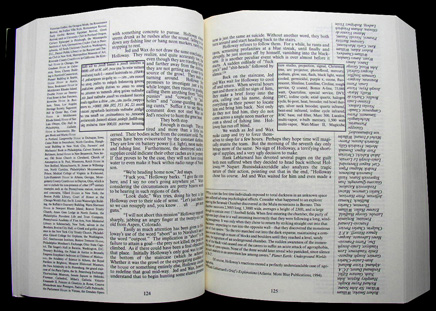
When people discuss this book, inevitably the novel's structure is one of the first things they talk about. And with good reason. Much like The Invention of Hugo Cabret used images to tell much of the narrative, so House of Leaves uses words to create images. Part of the reason why many people are reluctant to read this novel is because its sheer size is intimidating and because they see images like this:


Part of the chapter in which an expedition is launched inside the house to tackle the large spiral staircase that has grown within the dark and expansive interior, Danielewski uses footnotes in order to give the reader the impression that they too are walking down a never-ending staircase. Yet, for every page like this, there are pages like this:


Sitting on its side it doesn't look like much, but when you flip the book, it becomes a ladder of words, reflecting a ladder which one of the characters climbs in the book. There are even pages that have maybe one or two words on them, which means that for every page it takes you several minutes to read, there are entire sections of the book that you can get through in under a minute. But enough about the book's structure.

The plot itself is deep and interesting and the dizzying shifts between Zampanó's original text and Johnny Truant's footnote intrusions brings a uniqueness not found in other books. By making connections between the book and his own life, Truant subtly suggests to readers that there are connections to be made in their own lives. And there are. The characters that fill the pages of The Navidson Record are easy to relate to, which is quite a feat considering that their development is not constructed through a first person narrative like Johnny's but through a third person outside observer who shifts his focus from their troubles to anything from carbon dating to the story of Jacob and Esau.

Some have called House of Leaves a gimmick, but I prefer to see it as a refreshing break from the ordinary novel. Danielewski is a talented writer who uses both fact and fiction to create a terrifying story of family problems and personal struggles. This is not a story of monsters and boogeymen; it is far more chilling than that. House of Leaves is a book about how the extraordinary can either destroy a man or make him stronger. Just as it leaves the characters forever changed, it will leave the reader affected as well.

I'm giving House of Leaves 5 out of 5 Gabriels.


-Gabe

Monday, October 17, 2011

Resist the Temptation of the Beast: A Review of Perelandra by C.S. Lewis


Title: Perelandra
Author: C.S. Lewis
Edition: Hardcover
Publisher: Macmillan Co. (1944)
Pages: 238
Challenges: GoodReads 2011 Reading Challenge
How I Came by This Book: Nonners from Ridiculous Reviews has gotten me hooked on C.S. Lewis, first by suggesting that I read The Screwtape Letters and then insisting that I check out the first book of his Space Trilogy, Out of the Silent Planet. This is the second book in that trilogy, which I intend to finish by the end of this year. Perelandra was obtained at my library.


About the Author: Clive Staples Lewis (1898–1963) was one of the intellectual giants of the 20th century and arguably the most influential Christian writer of his day. His major contributions in literary criticism, children's literature, fantasy literature, and popular theology brought him international renown and acclaim. He wrote more than thirty books, allowing him to reach a vast audience, and his works continue to attract thousands of new readers every year. His most distinguished and popular accomplishments include The Chronicles of Narnia, Out of the Silent Planet, The Four Loves, The Screwtape Letters, and Mere Christianity. (taken from a much longer bio at HarperOne)

Synopsis: Written during the dark hours immediately before and during the Second World War, C. S. Lewis's Space Trilogy, of which Perelandra is the second volume, stands alongside such works as Albert Camus's The Plague and George Orwell's 1984 as a timely parable that has become timeless, beloved by succeeding generations as much for the sheer wonder of its storytelling as for the significance of the moral concerns. For the trilogy's central figure, C. S. Lewis created perhaps the most memorable character of his career, the brilliant, clear-eyed, and fiercely brave philologist Dr. Elwin Ransom. Appropriately, Lewis modeled Dr. Ransom after his dear friend J. R. R. Tolkien, for in the scope of its imaginative achievement and the totality of its vision of not one but two imaginary worlds, the Space Trilogy is rivaled in this century only by Tolkien's trilogy The Lord of the Rings. Readers who fall in love with Lewis's fantasy series The Chronicles of Namia as children unfailingly cherish his Space Trilogy as adults; it, too, brings to life strange and magical realms in which epic battles are fought between the forces of light and those of darkness. But in the many layers of its allegory, and the sophistication and piercing brilliance of its insights into the human condition, it occupies a place among the English language's most extraordinary works for any age, and for all time.

In Perelandra, Dr. Ransom is recruited by the denizens of Malacandra, befriended in Out of the Silent Planet, to rescue the edenic planet Perelandra and its peace-loving populace from a terrible threat: a malevolent being from another world who strives to create a new world order, and who must destroy an old and beautiful civilization to do so. (taken from GoodReads)

Review: While I obviously wrote a review of Out of the Silent Planet, I've found that, when I'm trying to actually talk to people about it, I'm never quite able to get at the heart of what I love about it. A friend of mine recently found the Space Trilogy at a used book store and while I was attempting to explain why he should read it, words actually failed me. Maybe I'm better at writing about books than I am at talking about them. Or maybe it's just that over time, as the book has settled into my brain, I've found so much to love about it that it all gets jumbled up on the way out.

With this undying adoration in mind, I turned to Perelandra, the second book in the trilogy. Once again Dr. Ransom travels from the safety of Earth to a far off planet--this time, Venus--and finds himself inextricably linked to what happens to the inhabitants of that world. I had been expecting another Out of the Silent Planet, with Ransom's humanity allowing him to connect with the Perelandrans and becoming a better man for it, and in some ways that was what I found. I was dismayed, however, by the fact that Perelandra was more of a treatise on temptation than it was a novel. Lewis' signature writing style--warm, sweeping, and highly imaginative--was present, but the book seemed to be more in line with The Screwtape Letters than with the first book in the trilogy.

I think The Screwtape Letters is a fantastic book and I would read it again in a heartbeat. That doesn't mean, however, that I enjoyed Perelandra. The book follows Ransom as he befriends one of only two sort-of human inhabitants on Venus. She is the Green Lady, the Eve of this world, and has become separated from her Adam (the King) due to the fact that most of the planet is water with a few floating islands and that Maledil (God) has forbidden either of them to live on the "fixed land." Soon after Ransom's initial encounter with her, Weston, one of the men who had kidnapped Ransom in the first novel, falls from the Perelandran sky in a space craft and begins trying to befriend the Green Lady as well. Ransom soon realizes that this is not Weston at all, but a demon, possibly even the Devil himself, using Weston's body in order to achieve his nefarious goal on that planet--to cause the Green Lady to disobey God, thereby leading once again to the Fall of Man.

Now, I have no problem with the premise of this novel. The idea is fascinating and I rather liked the Green Lady. I think she has a point when she insinuates that it is knowledge and not time that makes you older. I also think that this is a book that could have been done well had it not devolved into the three main characters sitting around talking the entire time. Lewis is a masterful writer and his ideas about philosophy and theology are usually well-reasoned--even if I don't agree with them, I enjoy reading what he has to say. But Out of the Silent Planet was a novel with a plot and it was exciting. Perelandra, while beautifully-written, was more an exploration of an idea than a novel.

Towards the end of the book, things did begin to pick up. I won't give anything away, but there are a few chapters that had me wondering what was going to happen next. These chapters soon gave way, however, to more of the same plodding narrative that I had come to associate with this book. To add insult to injury, the book's final chapter basically spiraled into a paean that lasted for way too long and that made me wonder whether or not Lewis had decided that the book was just a few pages too short and that he needed filler.

One thing that I did love about this book was how refreshingly unique everything was. Like Malacandra, everything about Perelandra was so different from anything I ever could have imagined and yet Lewis excels at description so I had no trouble picturing it all in my head. The thing that I've come to like most about Lewis' works is how fully they transport me to the worlds depicted within them. Perelandra is the rule in this respect, rather than an exception. While it took me a few chapters to get into the setting of the book--mostly because of the way the narration was delivered by someone outside of the story, which was distracting from time to time--once I was in, I was in. Perelandra became as real to me as Malacandra did and it was every bit as hauntingly beautiful.

As much as I would like to rate this book as highly as I've rated other Lewis books, I just can't. I wanted more doing and less saying. I missed the hnau of the first book (Lewis' characters might say that I was a backward-looking person and that I didn't appreciate the new because I was too attached to the old), as well as the feeling of inclusion that I had reading Out of the Silent Planet. Whereas that novel didn't bash you over the head with religiosity, Perelandra not only did, but did it with a sledgehammer. Gone was the universality that I had associated with Maledil and with the themes of the previous book. This one makes no bones about being a decidedly Christian narrative, which wouldn't be an issue if it weren't that it is so markedly different from the first novel. There is, of course, a reason for this--Malacandra represents the old ways of the universe, whereas Perelandra represents the new. The new, for Lewis, is Christianity.

There was a lot to like about this book, but there was even more that I disliked. I'm looking forward to reading That Hideous Strength, the last book in the trilogy, but I know that, when I do read it, I'll be going into it with a much more guarded approach. With two vastly different narratives preceding it, who knows what I'll find within its pages.

I'm giving Perelandra 3 out of 5 Gabriels.


Favorite Quote:
Ransom: How far does it go? Would you still obey the Life-Force if you found it prompting you to murder me?
Weston: Yes.
Ransom: Or to sell England to the Germans?
Weston: Yes.
Ransom: Or to print lies as serious research in a scientific periodical?
Weston: Yes.
Ransom: God help you! (p. 96-97)

I just love how Ransom seems to have his priorities a little mixed up.

-Gabe

PS: The title of this review was taken from lyrics to a 2Pac song. I've never heard it before, but a quick thank you to Google to finding a pretty fitting set of lyrics from the query "songs about temptation."