Wednesday, November 9, 2011
Red Riding Hood and Goldilocks Walk into a Bar: Reviews of Grimm ("Pilot" and "Bears Will Be Bears")
Title: Grimm
Airs: Fridays at 9 on NBC
Starring: David Giuntoli, Russell Hornsby, Silas Weir Mitchell
Contrary to what you might believe given the post I wrote back in March about some of my favorite shows, I don't actually watch television much. Or, really, at all. There are some shows that I got into while they were on television (the now-gone Alias, Jericho, and Stargate Universe and the still-running Big Bang Theory), but normally the shows that I get into are already cancelled and I just watch them on DVD (Battlestar Galactica, Stargate SG-1, Stargate Atlantis, The 4400). It saves me the trouble of having to wait a full week to see the next episode and, more importantly, it ensures that I don't have to be bombarded by mind-numbing and increasingly idiotic advertisements. I'm really picky when it comes to which shows I'll even give half a chance to and, as you can probably tell, the ones I end up liking tend to be sci-fi related.
When I heard that Robert Carlyle (The Fully Monty, Trainspotting, Stargate Universe) was going to be in a new television show I was curious to see what it would be like. I'm a huge fan of his work and I had heard that it was a fairy-tale related show, which piqued my interest. So, when someone mentioned that the show Grimm was going to be debuting the Friday before Halloween, I thought, "Hey, that must be the show, right?" It wasn't. Turns out that he's on ABC's Once Upon A Time, which I didn't realize until after I watched the second episode of Grimm. While I haven't seen the ABC take on fairy tales yet, I got hooked on NBC's within the first half of Grimm's pilot episode.
Given that this is a book blog and Grimm is a bookish television show, I've decided that I'll be reviewing the show on a weekly basis. It may not get posted the next day but it'll generally be sometime before the next episode airs. Today, you get a two-for-one deal because I didn't think about it until I was rewatching the episodes on Sunday night (thank you, NBC.com!).
Without further ado, here's my thoughts on the first two episodes of Grimm.
Warning: possible spoilers ahead.
"Pilot" (first aired October 28, 2011)
Plot: On the same day that his Aunt Marie (Kate Burton) comes for an unexpected visit, Nick Burkhardt (David Giuntoli) starts seeing people in a whole new light--literally. He's one of the last of the Grimm family and it's his gift (or curse) to see the creatures that haunt the folk tales and fairy stories of old. The brutal murder of a college student and the disappearance of a little girl (both wearing red hoodies) lead him to Eddie Monroe (Silas Weir Mitchell), a big bad wolf who's not so big and bad. Nick and Eddie work together to try and find the killer before he claims his next victim.
Review: I had gotten sick of police shows a long time ago. It doesn't matter if they get dressed up with fancy lighting or glitzy locales, they're all basically the same show rehashed over and over again. Grimm is nothing like these shows. It's not just that the criminals are supernatural beings; Grimm is a serial rather than a procedural and it has interesting characters and a good sense of humor in addition to its creepy atmosphere and fun twists on old stories.
This retelling of "Little Red Riding Hood" used its material well while still doing something new and fun. The juxtaposition of an age-old tale in a modern world reminds me a lot of The 10th Kingdom (a mini-series that was on NBC over a decade ago) but it's a lot scarier and a lot grittier. The episode started with a murder and continued to get more intense from there. The pace was good, with no real lulls in the action, and with an interesting way of using exposition. In the scene where Marie first starts to tell Nick about his family they get attacked by a creature called a Reaper. Definitely preferable to people just sitting around talking.
The characters, though, were what brought me back in front of the TV the next week, especially Mitchell's character, Eddie. Afterward, I had a short discussion on Twitter with someone who had said that the humor was a bit much for a show like Grimm and could be toned down, but I disagree. I think the humor, especially Eddie's, is what really sets this show apart from other cop shows, where everyone's so depressed and no one smiles. The partnership between Nick and Hank (Hornsby) is also fun to watch, although it's pretty similar to other cop partnerships out there. I much prefer the begrudging friendship that develops between Nick and Eddie. Eddie's reluctance to help Nick stems from the fact that his parents used to tell him stories about the Grimms and they "scared the hell" out of him and because (as we find out in the second episode) his family has a history of run-ins with the Grimms that never ended well. They're both fish out of water, really, and I like the idea of watching these characters develop as the season goes on.
I can't really find anything major to complain about for this episode. While the special effects aren't spectacular, they aren't horribly bad either, and everything else worked really well. The writing was good, the acting was good, and the story was engaging. I don't have a rating system for films or television shows worked out just yet, but the pilot episode of Grimm would most likely get the top grade.
_______
"Bears Will Be Bears" (first aired November 4, 2011)
Plot: A young couple, Gilda and Rocky, break into the home of an affluent family only to get more than they bargained for when Rocky gets attacked and Gilda barely gets away. Nick and Hank search for him while Eddie gets stuck standing guard over Nick's dying aunt--a woman whose family has a history of killing Eddie's ancestors.
Review: Each episode of Grimm starts out with a quote that helps the audience guess which story will be incorporated into the plot that evening. This time it was "Goldilocks and the Three Bears" and it was just as interesting a retelling as the first episode's version of "Red Riding Hood" had been. The regular characters from last week were back but they were joined by not only Gilda and Rocky but by the Rabe family...who aren't all that they seem.
This episode was great but I liked it better the second time around than I did the first. A lot of people who were talking about it on Twitter afterwards said that it was even better than the pilot, but I needed a rewatch to fully appreciate it, I think. There was a lot that went into "Bears Will Be Bears," which continued the thread of last week's episode while introducing a new case into the mix. Much like a lot of the other shows that I've loved, Grimm isn't episodic, which I like because I feel serialized shows are able to get more in-depth and are more likely to draw you in the following week because of a cliff-hanger or some other hook. This episode ended with one just like the first did and I'm already anxious to see Friday's episode.
I like Nick's character, but he's sort of a blank slate. We don't know a whole lot about him just yet (or his, to me, suspicious girlfriend), so I'm looking forward to being able to fill in the gaps. We find out a little more about Eddie and a little more about Hank, both of whom have become my two favorite characters (in that order). If they'd just build Nick up a bit more than these two he could be a really strong character but so far I think he pales in comparison to them...even though the show is about him.
Again, the special effects aren't fantastic, but I'm okay with that. I don't need the best CGI to enjoy something. If you compare, say, the original Star Wars trilogy to the crappy new Star Wars films, the originals were so much better because they focused more on creating amazing characters and exciting plots than they did creating a bunch of awe-inspiring special effects. I would take compelling show over technologically-advanced show any day.
And Grimm is compelling. You're always wondering what will happen next and very often you're surprised by what you find. Even though I swore I would never get addicted to a TV show again, Grimm has become my once-a-week fix. All it really needs is to develop the main character more and to keep Eddie's humor at its current level. I could tell that the second episode had toned him down a bit and, while I'm okay with that, any more toned down and he won't be the character I've already grown attached to.
Again, I don't have a rating system figured out yet (it's coming), but if I did, "Bears Will Be Bears" would be pretty high up the scale.
For those who haven't watched the show but are curious about it, you can watch the first two episodes on NBC's Grimm site. It's enough of a miracle that I'm watching a television show, but that I'm this enthralled with it means they've gotta be doing something right.
-Gabe
Labels:
crime,
fantasy,
folk tales,
Grimm,
horror,
review,
television
Tuesday, November 8, 2011
A New New Deal: A Review of Paul Krugman's The Conscience of a Liberal
Title: The Conscience of a Liberal
Author: Paul Krugman
Edition: Hardcover
Publisher: W.W. Norton & Co. (2007)
Pages: 273
Challenges: 2011 GoodReads Reading Challenge
How I Came by This Book: I borrowed this from the library the same day that I borrowed Barry Goldwater's The Conscience of a Conservative. I figured it would be interesting to see how the two were similar and different.
About the Author: Paul Krugman, who was named Columnist of the Year by Editor and Publisher magazine, writes a twice-weekly column for the op-ed page of the New York Times. A winner of the John Bates Clark Medal, the most prized award given to American economists, he also teaches economics and international affairs at Princeton University.
Synopsis: America emerged from Franklin Roosevelt's New Deal with strong democratic values and broadly shared prosperity. But for the past thirty years American politics has been dominated by a conservative movement determined to undermine the New Deal's achievements--a movement whose founding manifesto was Barry Goldwater's The Conscience of a Conservative. That movement has been highly successful in turning the clock back: both the inequality of today's America and the corruption of its political life hark back to the age of the robber barons.
Now, the tide may be turning--and in The Conscience of a Liberal Paul Krugman, the world's most widely read economist and one of its most influential political commentators, charts the way to reform.
Krugman ranges over a century of history, from the political economy of the Gilded Age--which seems all too familiar these days--to the calamities of the Bush years, which he argues where inevitable once movement conservatives gained full control of the U.S. government. he shows that neither the middle-class America the baby boomers grew up in nor the increasingly oligarchic nation we have become over the past generation evolved naturally: both were created, to a large extent, by government policies guided by organized political movements. He explains how defenders of inequality have exploited cultural and racial divisions to their advantage, while reformers have found ways to bridge those divisions. And he argues that the time is ripe for another great era of reform.
Last by not least, The Conscience of a Liberal outlines a program for change. It shows how universal health care can be the centerpiece of a New Deal, just as Social Security was the core of the original. It explains what can be done to narrow the wealth and income gap. And it shows how a new political coalition can both support and be supported by reform, making our society not just more equal but more democratic.
The Conscience of a Liberal promises to reshape public debate about American social policy and become a touchstone work for an entire generation.
Review: This review and the review I did yesterday can be seen as a sort of yin and yang type of thing. Goldwater wrote The Conscience of a Conservative as a way of shaping Conservative politics in order to move away from New Deal-type policies; Krugman wrote The Conscience of a Liberal several decades later in order to bring people back to the New Deal way of thinking. While I'm politically, fiscally, and socially liberal (and therefore agree far more with Krugman than with Goldwater), I felt that this book was much better than Goldwater's not because of what it said, but because of how it was said.
I've mentioned several times on this blog that I got my BA in history. I was taught the importance of using primary and secondary sources, of citing those sources correctly, and of using those sources in order to enhance your argument. I was also taught the value of being able to identify an author's bias. Obviously these skills benefit me both as a reader and as a writer, but they've also helped me as an individual. Being able to see the flaws in someone's argument or having the ability to understand why someone is saying something just make life a whole lot easier. So, of course, I can see the bias inherent in both this book and in Goldwater's treatise as well. Yet, I'm a lot more prone to support writers who provide evidence rather than simply relying on their opinions to write an argument.
Krugman's Conscience of a Liberal is a well-researched, well-cited book that takes a historical as well as a contemporary perspective on the issue of politics, economics, and society. He is highly critical of Conservative politicians (and engages in just as much blame as Goldwater does), but he gives a solid reasoning based on an exploration of the detrimental policies of the Gilded Age rather than just railing against Conservatives because he doesn't like them (even though it's obvious that he doesn't).
This book is a reaction to The Conscience of a Conservative as much as it is a reaction to the Bush presidency. Published prior to the 2008 election, Krugman can focus on criticism of one president without speculating on the next (simply because he hadn't been elected yet). He derives his solutions to contemporary problems both from an analysis of historical events as well as from an exploration of the (then) current socio-political climate. Goldwater, on the other hand, spent much of his book suggesting solutions based on little more than (what seemed like) gut feeling and deeply-held prejudices about everyone from poor people to Russians. Whereas Goldwater advocated for an economy basically based on social Darwinism, Krugman is more conscious of inequality and the systematic racism that has pervaded American society for far too long.
The only real issue I'd like to raise about this book was, despite being mostly straightforward in terms of writing style, Krugman is an economist, a subject in which I am no expert. Occasionally I had difficulty understanding some of what he was saying and I'm not really a graph/chart person so their presence was a bit distracting. They were, however, necessary to his point and almost everything was explained in easy-to-understand terms. There were only a few passages that were hard to get through, which is to be expected when the reader (i.e., me) has only a rudimentary understanding of how economics works.
Much like Goldwater's book was interesting to read in terms of the current goings-on in this country, so, too, is Krugman's. I honestly recommend reading the two of them together just to get an idea of the vast differences between parties. Too often I hear people saying that there's not a lot of difference between Democrats and Republicans or Conservatives and Liberals. Not only does Krugman blow that theory out of the water (at one point the parties were fairly similar but within the last thirty years they've grown so far apart that it's hard not to believe that the expanding universe theory might not apply to politics as well), but reading these books together shows just how different they truly are.
I'm giving The Conscience of a Liberal 4 out of 5 Gabriels.
-Gabe
Labels:
book review,
culture,
current events,
economics,
history,
liberal,
non-fiction,
politics
Monday, November 7, 2011
The League of Extraordinary Gentlemen Book Challenge 2012
2012 is almost upon us and that means a new year of reading challenges. Considering I've been pretty lax on completing the ones that I had signed up for this year, I was trying to be a good boy and not join as many next year. And then I saw this challenge on Sarah Says Read.
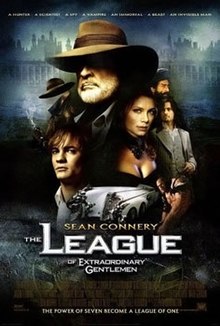
Hosted by Hanna at Booking in Heels, The League of Extraordinary Gentlemen Book Challenge is a year-long challenge that asks participants to read the books that each of the main characters in this film came from. Some I've already read and some I haven't, but I love a good reread so I don't mind.
I'm adding my own twist to the challenge and reading the original graphic novel by Alan Moore that the movie is (loosely) based on. I haven't read many (read: any) graphic novels other than Maus and I'd like to start.
I'll also be reviewing the film once I've finished all of the books. Here's what the challenge requires me to read:
1) King Solomon's Mines by H. Rider Haggard (Allan Quartermaine)
2) Dracula by Bram Stoker (Mina Harker) [reread]
3) 20,000 Leagues Under the Sea by Jules Verne (Captain Nemo)
4) The Adventures of Tom Sawyer by Mark Twain (Tom Sawyer) [reread]
5) The Picture of Dorian Gray by Oscar Wilde (Dorian Gray) [1/2 reread--I couldn't finish it the first time I read it.]
6) The Strange Case of Dr. Jekyll and Mr. Hyde by Robert Louis Stevenson (Dr. Jekyll and Mr. Hyde) [reread]
7) The Invisible Man by H.G. Wells (Rodney Skinner) [sort of]*
8) The Phantom of the Opera by Gaston Leroux (The Phantom) [reread]
9) The Final Problem by Sir Arthur Conan Doyle (James Moriarty)
And with my one addition:
10) The League of Extraordinary Gentlemen by Alan Moore
I'm more than a little excited about this challenge, which begins on January 1, 2012. If you're interested in signing up, head over to Booking in Heels!
-Gabe
*See Hanna's post for the reason for the "sort of."
Hosted by Hanna at Booking in Heels, The League of Extraordinary Gentlemen Book Challenge is a year-long challenge that asks participants to read the books that each of the main characters in this film came from. Some I've already read and some I haven't, but I love a good reread so I don't mind.
I'm adding my own twist to the challenge and reading the original graphic novel by Alan Moore that the movie is (loosely) based on. I haven't read many (read: any) graphic novels other than Maus and I'd like to start.
I'll also be reviewing the film once I've finished all of the books. Here's what the challenge requires me to read:
1) King Solomon's Mines by H. Rider Haggard (Allan Quartermaine)
2) Dracula by Bram Stoker (Mina Harker) [reread]
3) 20,000 Leagues Under the Sea by Jules Verne (Captain Nemo)
4) The Adventures of Tom Sawyer by Mark Twain (Tom Sawyer) [reread]
5) The Picture of Dorian Gray by Oscar Wilde (Dorian Gray) [1/2 reread--I couldn't finish it the first time I read it.]
6) The Strange Case of Dr. Jekyll and Mr. Hyde by Robert Louis Stevenson (Dr. Jekyll and Mr. Hyde) [reread]
7) The Invisible Man by H.G. Wells (Rodney Skinner) [sort of]*
8) The Phantom of the Opera by Gaston Leroux (The Phantom) [reread]
9) The Final Problem by Sir Arthur Conan Doyle (James Moriarty)
And with my one addition:
10) The League of Extraordinary Gentlemen by Alan Moore
I'm more than a little excited about this challenge, which begins on January 1, 2012. If you're interested in signing up, head over to Booking in Heels!
-Gabe
*See Hanna's post for the reason for the "sort of."
Labels:
books,
challenge,
classics,
film,
graphic novel,
science-fiction
Mommy, Where Do Republicans Come From?: A Review of Barry Goldwater's The Conscience of a Conservative
Title: The Conscience of a Conservative
Author: Barry Goldwater
Edition: Paperback
Publisher: Manor Books (1974)
Pages: 127
Challenges: 2011 GoodReads Reading Challenge
How I Came by This Book: As part of the research I'm doing for my book, I've been trying to find and read books by Conservative authors. Picking this book up was a no-brainer considering that many of the policies that Conservatives and Libertarians argue in favor of to this day come directly from or are derived from Goldwater's treatise. I borrowed this book from my library.
![]() |
About the Author: Barry Goldwater was a prominent Conservative theorist who helped to shape the Republican party. He was an Arizona State Senator for five terms and was also the 1964 Republican presidential nominee, losing to Lyndon B. Johnson. His stance on nuclear weapons led Johnson's campaign to run the famous "Daisy" ad (see below), which may have helped to seal the incumbent president's win in '64.
Synopsis: Senator Goldwater of Arizona has become the most influential exponent in this country of the theory that those least governed are best governed. Here he presents his alternatives to federal regulation in a wide variety of fields including:
-aid to education
-labor unions and labor policies
-individual income, as determined by tax policies
-civil rights
-care of the aged, the sick, the unemployed
Review: I don't think it would come as a shock to anyone who reads my blog regularly if I were to say unequivocally that I am and have always been a Liberal. With a capital L. Yet, I'm also a proponent of political debate, of listening to the other side, of compromising (only when it's for the best), and of learning all that you can about other viewpoints. So, while I went into this book knowing that I most likely would disagree with, um, everything in it, I still kept an open mind...for as long as I could.
I'm not here to extol the virtues of being a Liberal, nor am I here to convince you of why I find what Goldwater discusses in this book to be reprehensible. This is, after a book blog and not a political soapbox. So, I am hereby setting down my political junkie hat and putting on my book critic hat. This review is not about the content of Goldwater's book, but the book itself.
A slim and passionate volume, The Conscience of a Conservative, although ghostwritten, is attributed to Goldwater and is brimming with his own political ideas. Therefore, to make it easier for me to write about I'm just going to say that this is his book. From his views on education to his disdain for labor unions, Goldwater lays down his agenda, one which has inspired both political discourse and political discord for the last several decades. Although usually to the point, occasionally the book takes on a more flowery, grandiose tone which I think detracts from his message of staunch Conservatism. This isn't to say that Conservatives aren't allowed to be flowery or grandiose; they're just as welcome to have moments of pomposity as Liberals are. What I mean is that occasionally his arguments were a little hard to follow because of the way in which they were written. Other than that, this was an easy-to-read book, especially for those who are knowledgeable enough about the world of the the '60s and '70s (either by living through them or learning about them) to understand where Goldwater is coming from.
Like many political writers of either party, Goldwater throws a lot of blame around. Liberals, Communists, the UN, labor unions--all are seen by Goldwater as being culpable. For me, this is a good thing because my book is about the use of blame in society and politics, but for the casual reader this may get a bit tedious after a while. In the same vein, Goldwater states some things as being true (such as his idea that no country has ever survived being a "welfare state," which basically means providing education, health care, etc. through the government) without actually giving proof. He also doesn't cite anything so the whole book is basically his opinion and it's taken as a given that the reader will agree with him without any corroborating information.
The book is interesting, especially given what's taking place in politics today. Anyone looking for the origins of the Tea Party movement, Libertarianism, or other Conservative movements will find it here. As a political treatise it is pretty well-argued, but as a basis for government, I personally think that it falls short.
One of the most telling things about Conscience of a Conservative is Goldwater's stance on the Soviet Union and it's alleged manipulation of the U.N. For those who are following the United States' current involvement in the United Nations (especially its refusal to help fund UNESCO after the induction of Palestine into the organization), the parallels between what Goldwater rails against the USSR doing and what the U.S. is currently doing are striking.
I'm giving The Conscience of a Conservative 4 out of 5 Gabriels. While I don't agree with what this book espouses, nor do I appreciate the book's "this-is-the-only-way" attitude, it isn't a poorly-written book. I highly recommend reading it in order to get an idea of what helped to shape the current political climate.
-Gabe
Labels:
book review,
Cold War,
Conservative,
history,
non-fiction,
politics
Thursday, November 3, 2011
In Which I Cannot Properly Review a Book: A "Review" of Bill McKibben's The End of Nature
Title: The End of Nature
Author: Bill McKibben
Edition: Paperback
Publisher: Anchor Books (1989)
Pages: 226
Challenges: GoodReads 2011 Reading Challenge
How I Came by This Book: This was one of several books that I checked out of my library in order to research global warming.
About the Author: Bill McKibben is the author of a dozen books about the environment, beginning with The End of Nature in 1989, which is regarded as the first book for a general audience on climate change. He is a founder of the grassroots climate campaign 350.org, which has coordinated 15,000 rallies in 189 countries since 2009. Time Magazine called him 'the planet's best green journalist' and the Boston Globe said in 2010 that he was 'probably the country's most important environmentalist.' Schumann Distinguished Scholar at Middlebury College, he holds honorary degrees from a dozen colleges, including the Universities of Massachusetts and Maine, the State University of New York, and Whittier and Colgate Colleges. In 2011 he was elected a fellow of the American Academy of Arts and Sciences. (truncated from this bio on his website).
Synopsis: More than simply a handbook for survival or a doomsday catalog of scientific prediction, The End Of Nature is a groundbreaking plea for radical and life-renewing change. The author argues that for the world to survive, we must make a fundamental philosophical shift in the way we relate to nature. (from GoodReads)
Review: One of the reasons why I hate being behind on my reviews is that I'm reviewing books weeks (and, sometimes, months) after I've read them. Until the death of my internet connection, I had read a book, immediately written a review, and moved on to the next one. Until I get caught up, I won't be able to do that for a while. Why am I bringing this up in a book review? Because, for the life of me, I can't seem to remember much about this book.
Bill McKibben is a well-known name for many people who have been following the climate change debate. His books are included in the reading list at ClimateCrisis.net and he has written numerous articles, opinion pieces, and editorials over the years since The End of Nature came out in 1989. Despite all of this, however, I had yet to read anything that he had written. When I found this book in my library, I added it to my growing pile of books on climate change. Now I wish I had written a review of it (even if I'd had to do it on a giant rock with a hammer a chisel) immediately after I had set it down.
From what I can remember, I really enjoyed this book. Like the other books on global warming that I read around the same time, McKibenn's book was readable and it provided compelling evidence for his argument. I would have loved a bibliography or at least some citations, but it was a highly intelligent book that I remember reading fairly quickly.
As I'm flipping through the pages now, I'm remembering that the book seemed a little muted. Rather than a ranting, raving treatise, McKibben's book is a softer approach to the topic. The writing was often lyrical and the pages were brimming with calls to go back to the days where nature was revered, respected, loved. He talks about DDT and other chemicals, yes. He talks about changing weather patterns and other consequences of climate change, yes. But he does it in a way that evokes something primeval. He talks of the Appalachian Trail, of taking a hike. He raises images in the reader's head of places in the great outdoors that they've visited before. For me, it was Letchworth State Park and this little trail in a small town near Rochester. For other people, it will no doubt be their own local natural treasures.
This is a book of muted anger, of great sadness, and of deep trepidation. It's a book that was designed for the everyday reader, so it isn't bogged down by scientific mumbo-jumbo, although you do run into the occasional multiple-syllable word (but, really, who doesn't know what a chlorofluorocarbon is?). While apparently not as memorable as Under a Green Sky, The Discovery of Global Warming, or the soon-to-be-reviewed Field Notes from a Catastrophe, McKibben's book does touch on something deep. Perhaps it is not meant to be a book that sticks with you in terms of what he says; maybe it's a book meant to stick with you in terms of how it made you feel.
I'm not going to rate this book right now, mostly because I feel that if I had reviewed it right away, I would have had a lot more to say about it and would have been able to rate it fairly. I'm going to have to reread it sometime next year (I devoured the global warming books without taking notes, which is why I was reading them in the first place--doh!), so when I do, you can expect a much better review.
-Gabe
Labels:
book review,
climate change,
current events,
global warming,
nature,
non-fiction,
oops
Wednesday, November 2, 2011
The "Books I Should Have Read By Now" November Link-Up
Hello challenge participants!
There's only two more months left in the "Books I Should Have Read By Now" challenge...and you are all doing way better than I am. My current challenge count stands at 2 books. Which means that I'm going to have to either recuse myself from the challenge or read 12 classic novels by the end of the year (which may or may not be feasible). Either way, the challenge is still going on so don't forget to use this link-up to post links to your reviews.
Here's the October link-up for anyone who still needs to post reviews for last month.
-Gabe
There's only two more months left in the "Books I Should Have Read By Now" challenge...and you are all doing way better than I am. My current challenge count stands at 2 books. Which means that I'm going to have to either recuse myself from the challenge or read 12 classic novels by the end of the year (which may or may not be feasible). Either way, the challenge is still going on so don't forget to use this link-up to post links to your reviews.
Here's the October link-up for anyone who still needs to post reviews for last month.
-Gabe
Labels:
books I should have read by now,
challenge
Tuesday, November 1, 2011
Month in Review: October
It's been an age and a half since I've done a monthly review, but I'm going to get back into the habit if I have to glue myself to a chair at the end of every month.
After a dismal August and a non-existent September, Gabriel Reads is back up and blogging. With a backlog of reviews (some of which I still haven't written), I had no shortage of material this month. There are still 2 months left in the year and I've read 67 books out of my goal of 100. That means in November and December you should expect (and by "expect," I mean "demand) at least 33 more reviews.
So what did I do this month?
Reviews Written in October:
-Love at Absolute Zero by Christopher Meeks (my first blog tour review, complete with an interview with the author)
-The Art of Eating In: How I Learned to Stop Spending and Love the Stove by Cathy Erway
-Necropolis: London and Its Dead by Catharine Arnold
-Area 51: An Uncensored History of America's Top Secret Military Base by Annie Jacobsen
-Under a Green Sky: Global Warming, the Mass Extinctions of the Past, and What They Can Tell Us About Our Future by Peter D. Ward
-Will Grayson, Will Grayson by John Green and David Levithan
-Perelandra by C.S. Lewis
-The Discovery of Global Warming by Spencer R. Weart
-The Filter Bubble: What the Internet Is Hiding from You by Eli Pariser
-The Haunting of Hill House by Shirley Jackson
-Failed States: The Abuse of Power and the Assault on Democracy by Noam Chomsky
-Bossypants by Tina Fey
-The Dark Enquiry by Deanna Raybourn
-Kingdom Coming: The Rise of Christian Nationalism by Michelle Goldberg
-2030: The Real Story of What Happens to America by Albert Brooks
-Bias: A CBS Insider Exposes How the Media Distort the News by Bernard Goldberg
-House of Leaves by Mark Z. Danielewski
Favorite Book: The Haunting of Hill House
Least Favorite Book: Bossypants
-Gabe
After a dismal August and a non-existent September, Gabriel Reads is back up and blogging. With a backlog of reviews (some of which I still haven't written), I had no shortage of material this month. There are still 2 months left in the year and I've read 67 books out of my goal of 100. That means in November and December you should expect (and by "expect," I mean "demand) at least 33 more reviews.
So what did I do this month?
Reviews Written in October:
-Love at Absolute Zero by Christopher Meeks (my first blog tour review, complete with an interview with the author)
-The Art of Eating In: How I Learned to Stop Spending and Love the Stove by Cathy Erway
-Necropolis: London and Its Dead by Catharine Arnold
-Area 51: An Uncensored History of America's Top Secret Military Base by Annie Jacobsen
-Under a Green Sky: Global Warming, the Mass Extinctions of the Past, and What They Can Tell Us About Our Future by Peter D. Ward
-Will Grayson, Will Grayson by John Green and David Levithan
-Perelandra by C.S. Lewis
-The Discovery of Global Warming by Spencer R. Weart
-The Filter Bubble: What the Internet Is Hiding from You by Eli Pariser
-The Haunting of Hill House by Shirley Jackson
-Failed States: The Abuse of Power and the Assault on Democracy by Noam Chomsky
-Bossypants by Tina Fey
-The Dark Enquiry by Deanna Raybourn
-Kingdom Coming: The Rise of Christian Nationalism by Michelle Goldberg
-2030: The Real Story of What Happens to America by Albert Brooks
-Bias: A CBS Insider Exposes How the Media Distort the News by Bernard Goldberg
-House of Leaves by Mark Z. Danielewski
Favorite Book: The Haunting of Hill House
Least Favorite Book: Bossypants
-Gabe
Labels:
monthly review
Subscribe to:
Posts (Atom)